The Consumer Deception Crisis in Numbers: Why We're Investigating Product Claims
The scale of consumer deception - in numbers. Fake reviews, origin fraud, greenwashing, sciencewashing, and the proprietary illusion playbook.

$770 billion in fake reviews. Fabricated awards. "Proprietary" technology that isn't. And the science behind why you fall for it.
Every year, hundreds of billions of dollars change hands based on product claims that don't hold up to scrutiny. Not from dark-web scammers or phishing emails, but from real brands, on real store shelves, with real celebrity endorsements and real awards on the packaging.
We built Material Truths to investigate those claims. Specifically, the gap between what brands say about their products and what the materials, patents, and science actually show. Before we publish our first investigation next week, here's the scale of what we're looking at.
The Broken Marketplace
The foundation of online shopping is reviews. The foundation is cracked.
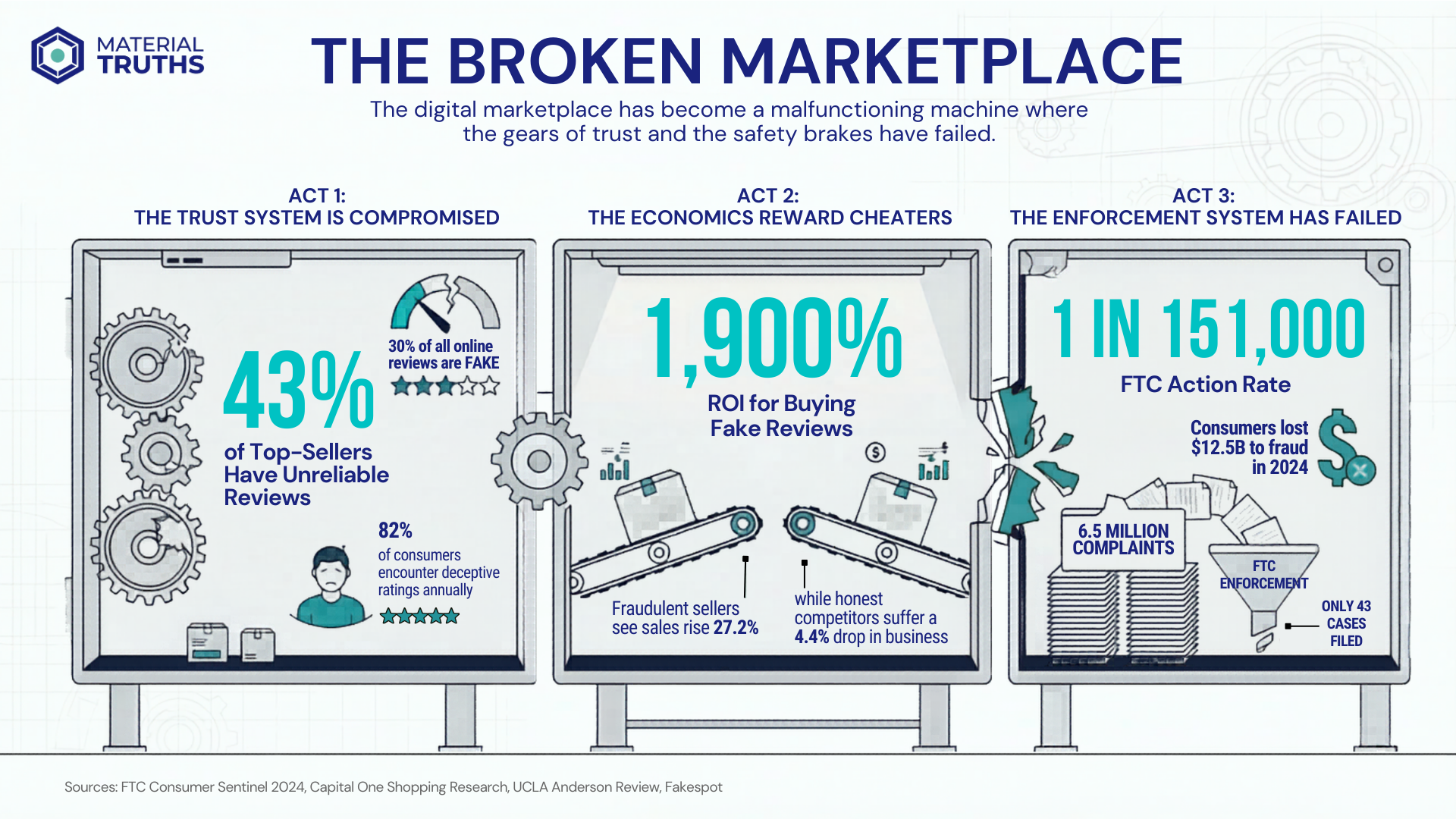
An estimated 30% of online reviews are fake or inauthentic. On Amazon's bestselling products, that rate climbs to 43%. In fashion and jewelry categories, a Fakespot analysis found 88% of reviews were deemed unreliable.
Amazon's own 2024 Brand Protection Report states the company blocked over 275 million suspected fake reviews that year. Yet the practice persists because the economics overwhelmingly favor cheaters. The FTC estimates that businesses buying fake reviews see a 1,900% return on investment. Research from UCLA's Anderson School found that sellers using fake reviews raised prices and saw unit sales increase 27.2%, while honest sellers watched their sales decline 4.4% and were forced to lower prices to compete.
And the agency responsible for policing all of this? The FTC received 6.5 million consumer complaints in 2024. It filed 43 federal court cases. That's an action rate of approximately 1 in 151,000 complaints. Only 2.7% of the $12.5 billion in reported fraud losses were returned to consumers.
Deception Across Every Category
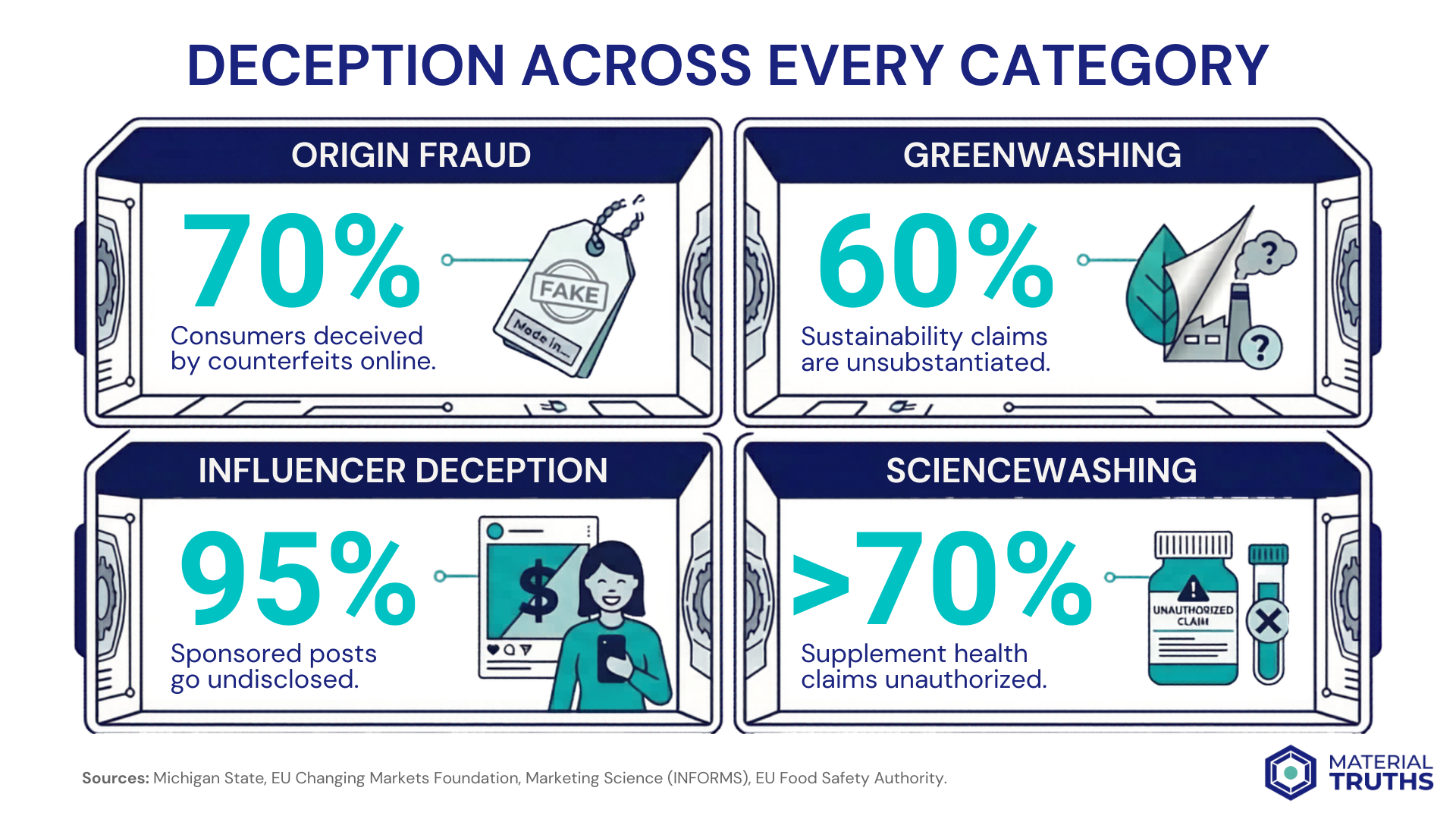
Fake reviews are only one vector. The same deception patterns appear across every dimension of consumer products.
Origin fraud is surging. A Michigan State University survey of 13,000 consumers across 17 countries found that 70% were deceived into buying counterfeit products online at least once in the past year. As of December 2025, at least 20 "Made in USA" consumer class actions had been filed, nearly three times the 7 filed in all of 2024. A 2024 investigation into Williams-Sonoma found over 800 products marketed as "Made in the USA" or "Crafted in America" that were actually imported, resulting in a $3.18 million penalty, the largest in FTC history for such a case. Nearly 90% of all counterfeit goods seized by U.S. Customs in FY 2024 originated from China and Hong Kong.
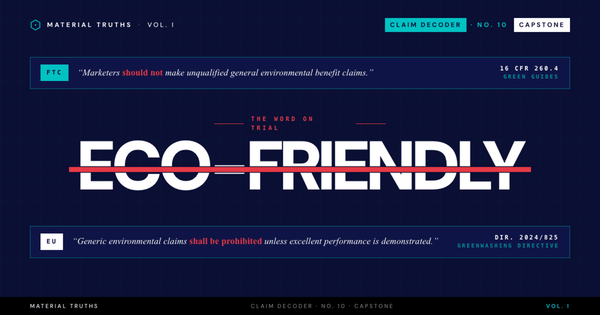
Sustainability claims are routinely fabricated. Approximately 60% of fashion brands' sustainability claims have been identified as unsubstantiated or misleading. A survey reported by Woola found that 68% of US executives admit to using greenwashing tactics. Truth in Advertising (TINA.org) has tracked over 150 class-action lawsuits over misleading environmental claims since 2015.
Fake certifications are a documented enforcement target. The FTC has brought enforcement actions against companies that created and awarded their own certification seals, including a baby mattress company that invented a fake "Green Safety Shield" and a supplement company that operated its own "Certified Ethical Site" seal (resulting in a $1.3 million judgment). The BBB has warned about vanity award schemes charging $57 to $599+ for badges that require no competitive judging, testing, or peer review.
Influencer marketing operates with minimal disclosure. A peer-reviewed study published in Marketing Science analyzing over 100 million brand-related tweets found that 95-96% of sponsored influencer posts were never disclosed as advertising. The UK's Advertising Standards Authority monitored 52,239 pieces of content and found only 57% of influencer ads were adequately disclosed, with 82% of non-compliant ads containing zero disclosure whatsoever.
These are not isolated failures. They are structural features of how consumer products are marketed and sold.
Sciencewashing & The Proprietary Illusion
This is the pattern Material Truths was built to investigate.
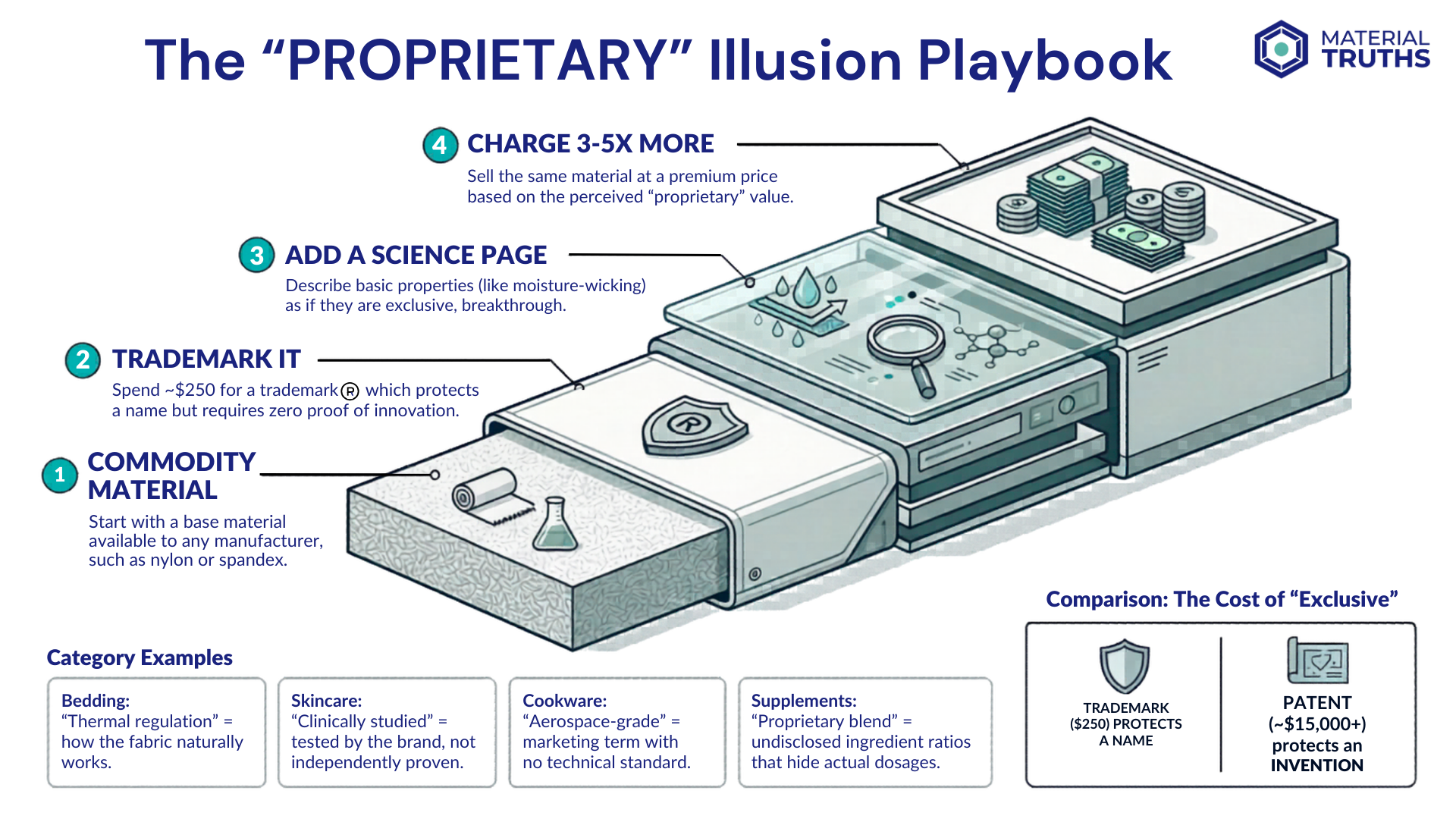
Across consumer product categories (bedding, cookware, supplements, skincare) we've identified a recurring playbook. It works like this:
Step 1: Start with a commodity material, something any manufacturer can buy from the same suppliers.
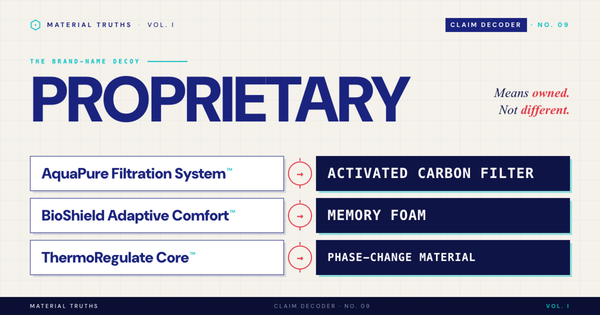
Step 2: Register a trademark on a branded name. The ® symbol costs approximately $250 to obtain and requires zero proof of technical innovation. It protects the name, not the product.
Step 3: Build a "science page" on your website that describes the inherent properties of your commodity material in scientific language. If it's bedding, talk about thermal regulation. If it's skincare, say "dermatologist tested" or "clinically studied." If it's cookware, call it "aerospace-grade." If it's a supplement, reference a study that tested the ingredient, without mentioning whether it actually worked. These are either inherent material properties or meaningless qualifiers. They're not unique to your product.
Step 4: Add credibility layers (celebrity endorsements, publication awards, validation partnerships) and price the product at three to five times what competitors charge for the same base material.
We call this the "proprietary illusion." A trademark protects a name. A patent protects an invention. The difference in cost and rigor is significant: registering a trademark costs about $250, while obtaining a patent typically costs $5,000 to $15,000+ and requires demonstrating genuine novelty. When a brand uses trademarked names and technical language to create an impression of exclusive technology without holding any patents on the underlying product, consumers deserve to know the difference.
Why Sciencewashing Works: The Cognitive Science
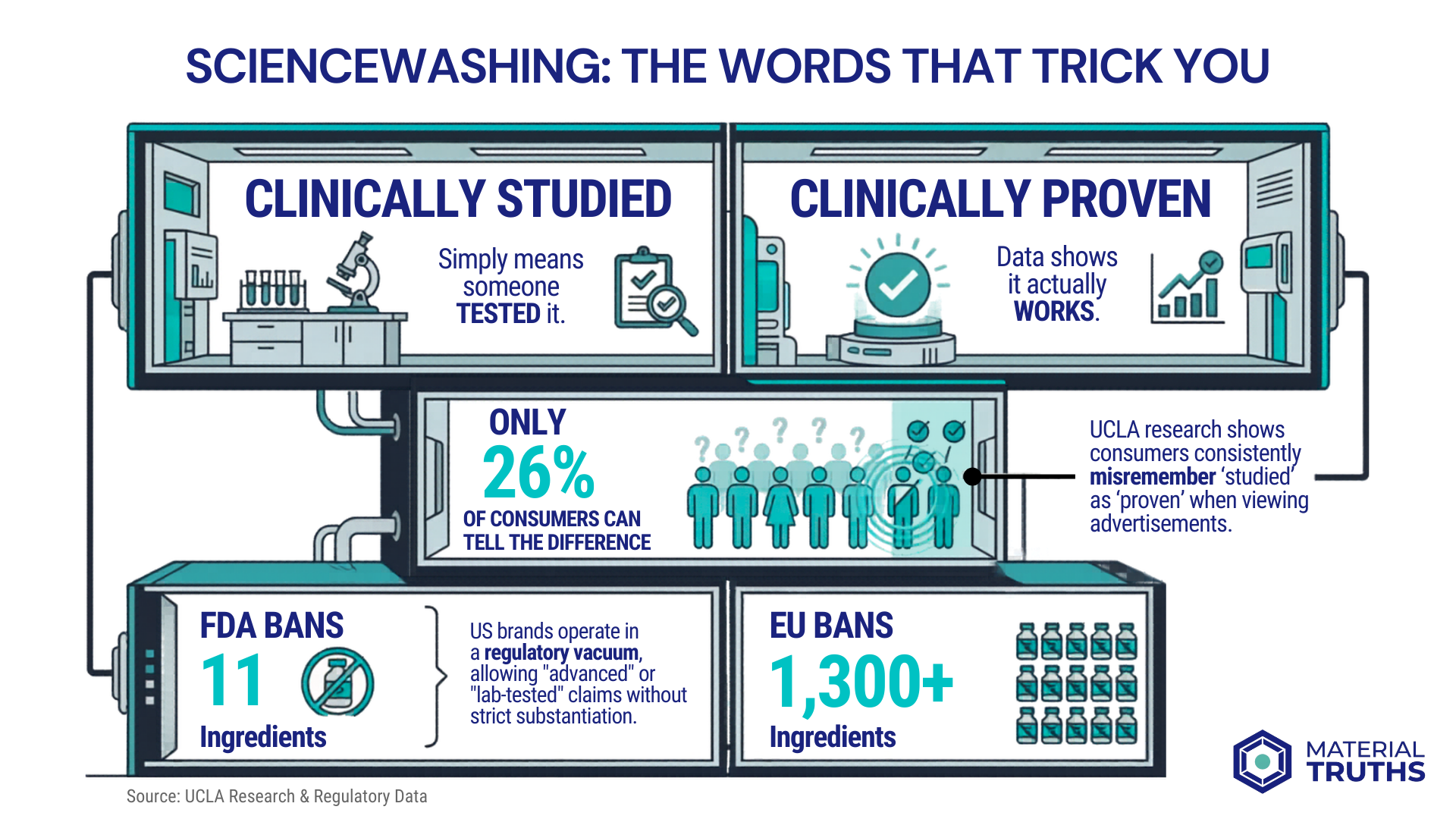
The industry term for using clinical-sounding language to make ordinary products seem revolutionary is "sciencewashing." And it works because of how our brains process these claims.
A UCLA study published in Applied Cognitive Psychology found that only 26% of consumers could correctly remember whether a supplement advertisement said "clinically studied" or "clinically proven." Most participants consistently misremembered "studied" as "proven," even though those phrases mean fundamentally different things. "Clinically studied" means someone ran a test, with no requirement that the product was shown to work. "Clinically proven" implies demonstrated efficacy in controlled trials. Brands exploit this cognitive gap deliberately.
The consequences are real. The FTC spent seven years litigating against Prevagen, a memory supplement that generated $165 million in U.S. sales. The company's marketing included claims like "clinically shown to improve memory." In December 2024, a jury found that none of the eight challenged claims were supported by competent scientific evidence. The company's own study failed to show statistically significant improvement. The positive results they marketed came from cherry-picked subgroup data, a practice researchers call "p-hacking."
The NAD's 2024 annual report showed dietary supplement complaints jumped to 12% of all cases, up from just 3% the year before. Fast-Track challenges nearly tripled over three years. The FDA issued a 50% increase in warning letters in FY 2025, with 327 letters in just five months, a 73% increase over the same period in 2024.
And the regulatory vacuum is wider than most consumers realize. The U.S. FDA bans just 11 cosmetic ingredients. The European Union bans over 1,300. In that gap, the language on the label effectively becomes the product. There is almost no regulatory mechanism requiring brands to substantiate "proprietary," "advanced," or "lab-tested" claims before they reach consumers.
This is what Material Truths investigates. Not the reviews. The product itself. The materials. The science pages. The patent databases. The gap between what a brand claims and what the evidence shows.
The AI Accelerant: Why It's Getting Worse
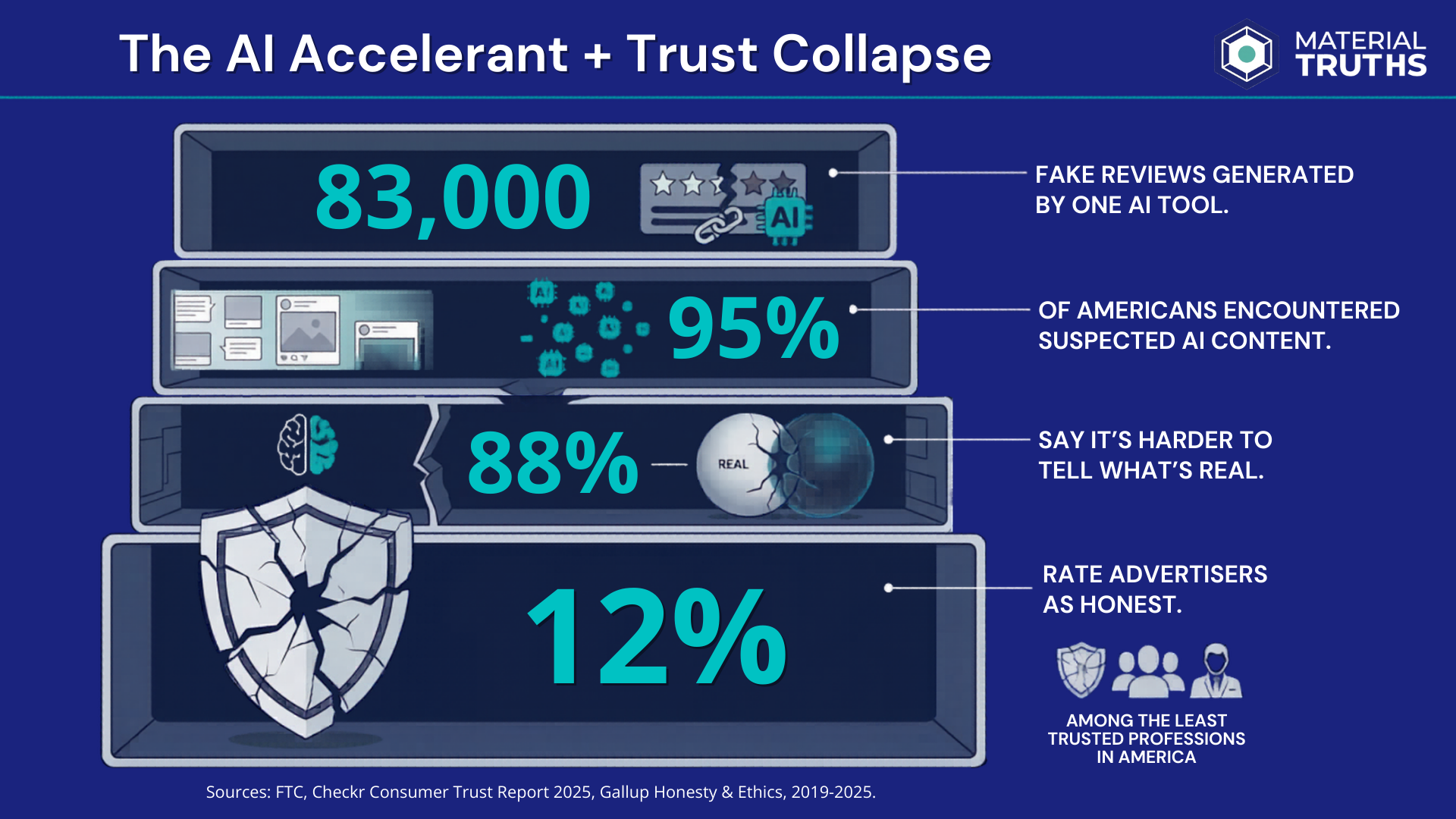
Every deception pattern documented above is now being supercharged by artificial intelligence.
A November 2025 survey of 3,000 Americans by Checkr found that 95% have encountered content they suspected was AI-generated, including altered photos or videos (76%), fake social media accounts (53%), and overly polished product reviews (49%). A full 88% said it's harder now than a year ago to tell what's real online.
The impact on reviews is particularly acute. The FTC took action against AI writing tool Rytr after its platform was used to generate over 83,000 fake reviews for a single business category. In Singapore, a company used ChatGPT to generate fake 5-star reviews posted under real customers' names without consent. Academic research found that AI-generated fake reviews demonstrate higher readability and fewer linguistic red flags than human-written fakes, making them significantly harder to detect.
Consumer trust has eroded to historic lows. Gallup's December 2025 poll found that only 12% of Americans rate advertising practitioners' honesty and ethics as "very high" or "high," ranking them alongside car salespeople and lobbyists at the bottom of all professions measured. Deloitte's 2025 Connected Consumer Survey found that 74% of consumers familiar with generative AI say its popularity makes it harder to trust what they see online.
Meanwhile, the enforcement safety net is shrinking. The FTC's consumer protection budget faces an $18.6 million cut for FY 2026, with staff targeted at approximately 1,100 FTE, the lowest level in a decade. The Consumer Financial Protection Bureau was cut from approximately 1,700 employees to 200, a roughly 90% reduction, despite having returned $21 billion to consumers since its inception. A GAO report in April 2025 found that no comprehensive government-wide strategy to counter scams even exists.
AI can generate unlimited marketing language, but it can't fabricate a USPTO patent filing, alter an Amazon product composition listing, or rewrite the laws of material physics. The evidence trail that Material Truths follows is the part that can't be faked.
What Material Truths Does Differently
Material Truths is an independent consumer investigation platform. We have direct experience in product development and materials science. We don't accept payment for investigations, and we have no affiliate relationships with any brand we cover.
Our methodology is specific: we evaluate the claims brands make about their products, especially claims of proprietary technology, patented innovation, and scientific superiority, and check them against publicly available evidence. We search patent databases. We identify actual material compositions from product listings and lab data. We compare what a brand's "science page" claims against what the underlying materials actually do. And we publish our findings with every source linked, every screenshot documented, so you can verify our work.
We're not a review site. We don't tell you what to buy. We investigate whether the science behind what you're buying holds up to scrutiny.
What's Coming Next
Next week, we're publishing our first full investigation. We looked at an award-winning, celebrity-endorsed bedding brand that calls its fabric "proprietary technology." We checked the patent databases. We identified the fabric composition. We compared it against what's available from other brands.
And then the brand's own website confirmed everything we suspected.
Subscribe below to get it when it publishes.
Frequently Asked Questions
How much do fake reviews cost consumers?
Fake reviews are estimated to cost consumers approximately $770.7 billion worldwide in 2025, according to research compiled by Capital One Shopping. This figure is projected to reach $1.07 trillion by 2030. On Amazon specifically, 43% of bestselling products have unreliable reviews, and the rate reaches 88% in fashion and jewelry categories.
What percentage of online reviews are fake?
Research estimates that an average of 30% of online reviews are fake or inauthentic. Amazon reported blocking 275 million suspected fake reviews in 2024 alone. The FTC estimates businesses buying fake reviews see a 1,900% return on investment, which is why the practice persists despite platform enforcement.
What is the difference between a trademark and a patent?
A trademark (®) protects a brand name. It prevents competitors from using the same name for similar products. It costs approximately $250 to register and requires no proof of innovation. A patent protects a novel invention. It requires demonstrating that the invention is new, useful, and non-obvious. Patents typically cost $5,000-$15,000+ to obtain. Many consumers see the ® symbol and assume it signals patented technology, but it only means the name is legally protected.
What is sciencewashing?
Sciencewashing is the practice of using clinical-sounding language, technical terminology, or cherry-picked data to make ordinary products appear scientifically advanced or medically validated. Common tactics include describing inherent material properties as proprietary innovations, using phrases like "clinically studied" (which only means tested, not proven effective), and building "science pages" that present basic product attributes in technical language. A UCLA study found only 26% of consumers can distinguish "clinically studied" from "clinically proven."
What is the difference between "clinically studied" and "clinically proven"?
"Clinically studied" means a product was included in some form of clinical testing, with no requirement that the testing showed it worked. "Clinically proven" implies the product demonstrated efficacy in controlled clinical trials. Brands frequently use "clinically studied" because it sounds authoritative but requires far less scientific evidence. A UCLA study found that consumers consistently misremember "studied" as "proven," which is why brands favor the weaker claim.
How is AI making consumer deception worse?
AI enables the generation of fake reviews, fake influencer content, and technical-sounding marketing copy at unprecedented scale and quality. A single AI tool generated 83,000 fake reviews for one business category. Research shows AI-generated fake reviews are harder to detect than human-written fakes because they have higher readability and fewer linguistic red flags. A 2025 survey found 95% of Americans have encountered suspected AI-generated content, and 88% say it's harder to tell what's real than a year ago.
How can consumers verify product claims?
Consumers can search any US trademark at tsdr.uspto.gov. For patents, Google Patents allows free searches. Amazon product listings disclose fabric type and composition in the product information section. For "Made in USA" claims, the FTC requires "all or virtually all" of the product is made domestically. Third-party certifications can be verified on the certifying organization's website. When a brand claims "proprietary technology," ask: is there a patent number? If not, the ® symbol only protects the name.
Sources
All statistics cited in this article are linked to their original sources throughout the text. Primary data sources include:
- FTC Consumer Sentinel Network Data Book 2024 (March 2025)
- FTC Annual Performance Report FY 2024
- Amazon 2024 Brand Protection Report (March 2025)
- Capital One Shopping: Fake Review Statistics (2025)
- Fakespot Analysis via Shapo (2025)
- UCLA Anderson Review: How Fake Reviews Distort Markets (2025)
- UCLA / Applied Cognitive Psychology: Clinically Studied vs Proven
- FTC: Prevagen Verdict (December 2024)
- NAD 2024 Annual Report
- FDA Warning Letter Surge FY 2025
- Saul Ewing: FDA vs EU Cosmetic Ingredient Bans
- Mintz Law: Made in USA Claims (December 2025)
- Michigan State University: Consumer Counterfeit Survey (2023, 13,000 participants)
- US Customs and Border Protection (FY 2024)
- Woola: Greenwashing Statistics (2025)
- TINA.org: Greenwashing Class-Action Lawsuits (March 2025)
- FTC: Self-Certification Enforcement (2017)
- BBB: Vanity Awards
- Marketing Science (INFORMS): Influencer Disclosure Study (2025)
- UK ASA: Influencer Disclosure Report (May 2025)
- Checkr: Consumer Trust Report 2025 (November 2025)
- Gallup: Honesty and Ethics Poll (December 2025)
- Deloitte: 2025 Connected Consumer Survey
- DLA Piper: FTC Fake Reviews and AI (December 2025)
- FTC FY 2026 Congressional Budget Justification
- GAO: Government-Wide Scam Strategy (April 2025)
- Federal News Network: CFPB Workforce Reduction (April 2025)