What "Eco-Friendly" Legally Means: FTC Green Guides Cautions Against the Whole Phrase

Last updated: May 27, 2026
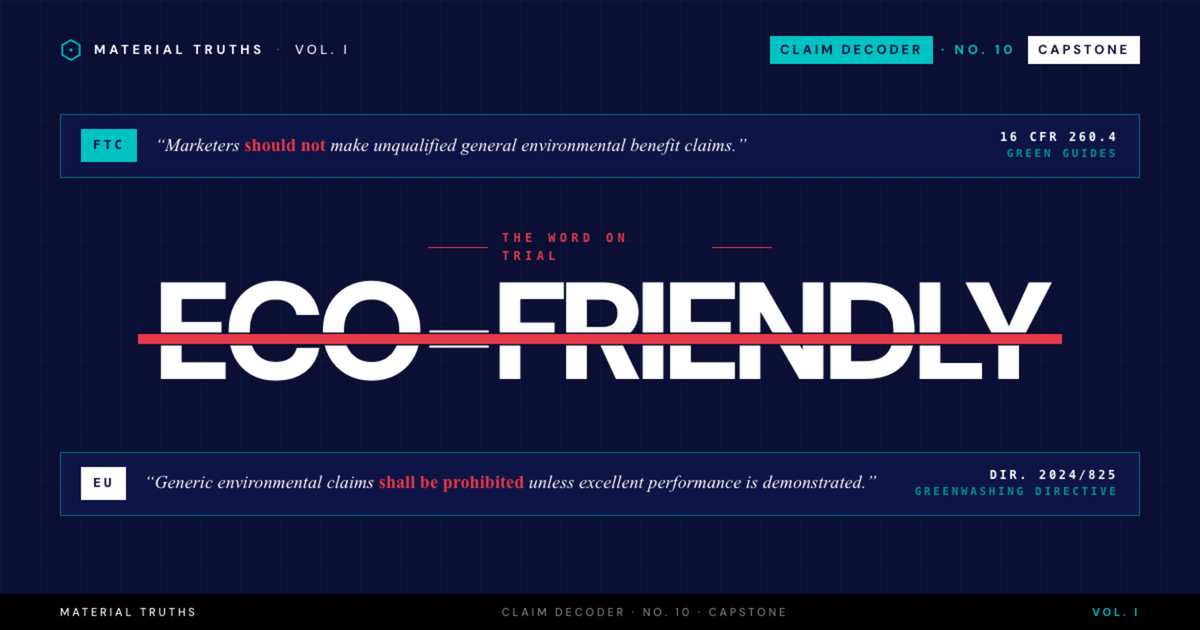
The FTC Green Guides at 16 CFR 260.4 specifically caution against unqualified "eco-friendly" claims — along with "green," "sustainable," and "environmentally friendly." The FTC's position is that these general claims imply broad environmental benefits few products can substantiate. Brands using them must qualify the claim with specific environmental attributes and provide competent and reliable scientific evidence. The EU Greenwashing Directive, with rules applying from September 2026, goes further and effectively prohibits these unqualified claims for products sold in Europe. Despite these frameworks, "eco-friendly" remains one of the most widely misused marketing terms in consumer products.
What does "eco-friendly" legally mean?
The FTC's Guides for the Use of Environmental Marketing Claims at 16 CFR Part 260 directly address general environmental benefit claims. Section 260.4 is the key provision. It states that marketers should not make unqualified claims of general environmental benefit because consumer perception testing demonstrates that such claims convey multiple meanings, including the implication that a product has no negative environmental impact — which essentially no product can substantiate.
The specific FTC language: "Unqualified general environmental benefit claims are difficult to interpret and likely convey a wide range of meanings. In many cases, such claims likely convey that the product has specific and far-reaching environmental benefits and may convey that the item or package has no negative environmental impact. Because it is highly unlikely that marketers can substantiate all reasonable interpretations of these claims, marketers should not make unqualified general environmental benefit claims."
Terms specifically called out:
- "Eco-friendly"
- "Green"
- "Sustainable"
- "Environmentally friendly"
- "Environmentally preferable"
- "Environmentally safe"
All fall under the same caution. All require qualification with specific environmental benefit information before use.
Why is "eco-friendly" hard to substantiate?
Any product's environmental impact includes multiple dimensions over its full lifecycle:
- Raw material extraction and sourcing
- Manufacturing energy and emissions
- Packaging impact
- Distribution and shipping emissions
- Use phase energy and resource consumption
- End-of-life disposal or recycling impact
A product can perform well on one dimension and poorly on others. Recyclable packaging from a product manufactured in high-emission conditions is not "eco-friendly" in any net sense — it's recyclable packaging on an otherwise conventional product.
When consumers see "eco-friendly," reasonable interpretations include:
- The product has net positive environmental impact
- The product is better for the environment than conventional alternatives
- The product causes minimal environmental harm
- The product is sustainably sourced and produced
- The product breaks down safely at end of life
Few products can substantiate all of these. Claims requiring substantiation of interpretations the brand didn't intend are the FTC's specific concern.
What substantiation requires
Under the Green Guides' general substantiation provisions (16 CFR 260.2) and Section 5 of the FTC Act, marketers making environmental claims need competent and reliable scientific evidence. The FTC defines this as "tests, analyses, research, or studies that have been conducted and evaluated in an objective manner by qualified persons and are generally accepted in the profession to yield accurate and reliable results."
For "eco-friendly" claims specifically, substantiation typically requires:
- Life cycle assessment (LCA). Published third-party LCAs quantifying environmental impact across dimensions.
- Specific attribute measurement. What specifically is "eco-friendly" about the product? Recyclability percentage? Renewable content percentage? Energy efficiency ratio?
- Comparison baseline. Eco-friendly compared to what? Conventional products of the same type? Previous versions of the same brand?
- Third-party certification. Where available, certifications from independent standards organizations substantiate specific attributes.
A brand claiming "eco-friendly" without answering these substantiation requirements is making an unqualified general environmental claim prohibited under the Green Guides.
Real certifications that substantiate specific eco claims
No certification is specifically called "eco-friendly," but several address verifiable environmental attributes:
ENERGY STAR (energystar.gov). EPA/DOE program for energy efficiency in appliances, electronics, buildings. Specific testing standards; searchable database.
USDA Organic (usda.gov/topics/organic). Certifies absence of prohibited substances in food and agricultural products. Specific standards under the National Organic Program.
Forest Stewardship Council / FSC (fsc.org). Certifies sustainable forestry for wood and paper products. Chain-of-custody requirements trace materials from forest to product.
Fair Trade (fairtradecertified.org). Certifies labor and supply chain practices. Addresses social sustainability more than environmental but often invoked in eco-friendly context.
EPA Safer Choice (epa.gov/saferchoice). Evaluates cleaning and similar products against specific chemical screening criteria.
Rainforest Alliance (rainforest-alliance.org). Supply chain certification addressing deforestation, biodiversity, and community impact.
Cradle to Cradle Certified (c2ccertified.org). Multi-attribute assessment of circular design principles.
Green Seal (greenseal.org). Institutional cleaning products, paints, paper, and other categories.
B Corporation (bcorporation.net). Corporate-level certification addressing overall social and environmental practices. Not product-specific.
OEKO-TEX STANDARD 100 (oeko-tex.com). Textiles tested for harmful substances. Addresses some eco-friendly interpretations, particularly for apparel and home textiles.
Brands making "eco-friendly" claims without any of these or equivalent certifications rely on unsubstantiated general claims the FTC specifically cautions against.
The EU Greenwashing Directive changes the landscape
The European Union's Empowering Consumers for the Green Transition Directive (Directive 2024/825) represents a significant tightening of green marketing rules. Implementation timeline:
- March 27, 2026: EU member states must transpose the directive into national law
- September 27, 2026: Rules apply to products sold in EU markets
Key provisions:
- Unqualified general environmental claims prohibited. "Eco-friendly," "green," "sustainable," "climate-neutral," and similar unqualified claims are effectively prohibited unless backed by recognized excellent environmental performance.
- Carbon-neutral claims based on offsetting prohibited. A major change — brands cannot claim carbon-neutrality by purchasing carbon offsets, regardless of offset quality.
- Self-certified labels restricted. Brands cannot create their own certification seals. Only independent third-party certifications meeting specific criteria are permitted.
- Future performance claims require monitored implementation plans. "Net zero by 2030" requires documented implementation plans subject to external monitoring.
Products sold in EU markets — including those imported from the U.S. — must comply regardless of brand origin. For multinational brands, this creates a de facto global standard; the simpler path is typically to bring global marketing into EU compliance rather than maintain separate messaging for different markets.
U.S. federal rules have not adopted equivalent restrictions. The FTC has been considering revisions to the Green Guides since 2022 but has not finalized updates. State-level rules, particularly in California, align more closely with EU requirements.
Common eco-friendly deception patterns
Specific patterns the FTC treats as deceptive:
Single-attribute amplification. Recyclable packaging on a conventionally manufactured product marketed as eco-friendly. The single attribute is truthfully claimed; the overall impression is misleading.
Imagery without substance. Green color schemes, leaf graphics, pastoral imagery, and earth-tone packaging used to suggest environmental identity without substantive claims. Green Guides address this — imagery can constitute implied claims requiring substantiation.
Unspecified comparatives. "Made with less plastic" — less than what? "More sustainable than ever" — more than what? Comparative claims without disclosed baselines are unsubstantiated.
Self-created certification seals. Brand-designed seals that imply third-party certification. "Certified Eco-Responsible™" is not a certification if the brand itself granted it.
Aspirational claims without accountability. "Net zero by 2030" without current action or monitored implementation is an empty commitment.
Carbon-neutral based on offsets. Historically common, increasingly challenged. Even when legal (U.S. still permits offset-based claims with proper disclosure), quality of offsets varies widely. EU is prohibiting these claims entirely.
Each of these appears in our greenwashing reference page.
Frequently asked questions
What does "eco-friendly" legally mean? FTC Green Guides at 16 CFR 260.4 caution against unqualified general environmental benefit claims. Substantiation requires specific benefit information and competent and reliable scientific evidence.
Can any product be truly eco-friendly? Almost no product has net-positive environmental impact across its full lifecycle. "Compared to what?" is the essential question.
What certifications substantiate eco claims? ENERGY STAR, USDA Organic, FSC, Fair Trade, EPA Safer Choice, Rainforest Alliance, Cradle to Cradle, Green Seal, B Corporation, OEKO-TEX STANDARD 100.
Common deception patterns? Single-attribute amplification, green imagery without substance, unspecified comparatives, self-created seals, aspirational claims, offset-based carbon-neutral claims.
EU Greenwashing Directive changes? Effective September 2026. Prohibits unqualified green claims, carbon-neutral via offsetting, and self-certified labels.
How should "eco-friendly" be qualified to be substantiable? Specify the attribute, comparison baseline, supporting evidence, and limitations.
Further reading
- Greenwashing: The broader pattern
- Claim decoder: "Non-Toxic": Adjacent environmental claim
- Made in USA: Country-of-origin claims often intersect with eco-friendly claims
- Sciencewashing: Related deception category
Sources
- FTC. "Guides for the Use of Environmental Marketing Claims." 16 CFR Part 260, specifically §260.4 General environmental benefit claims. ftc.gov/legal-library/browse/rules/green-guides
- 16 CFR 260.2 — Interpretation and substantiation.
- European Commission. "Empowering Consumers for the Green Transition Directive" (Directive 2024/825). Implementation by March 27, 2026; rules apply September 27, 2026.
- EPA ENERGY STAR. energystar.gov
- USDA National Organic Program. usda.gov/topics/organic
- Forest Stewardship Council. fsc.org
- Fair Trade Certified. fairtradecertified.org
- EPA Safer Choice. epa.gov/saferchoice
- Cradle to Cradle Products Innovation Institute. c2ccertified.org