"Proprietary" Claims: What They Legally Cover and Where They Fall Short

Last updated: May 26, 2026
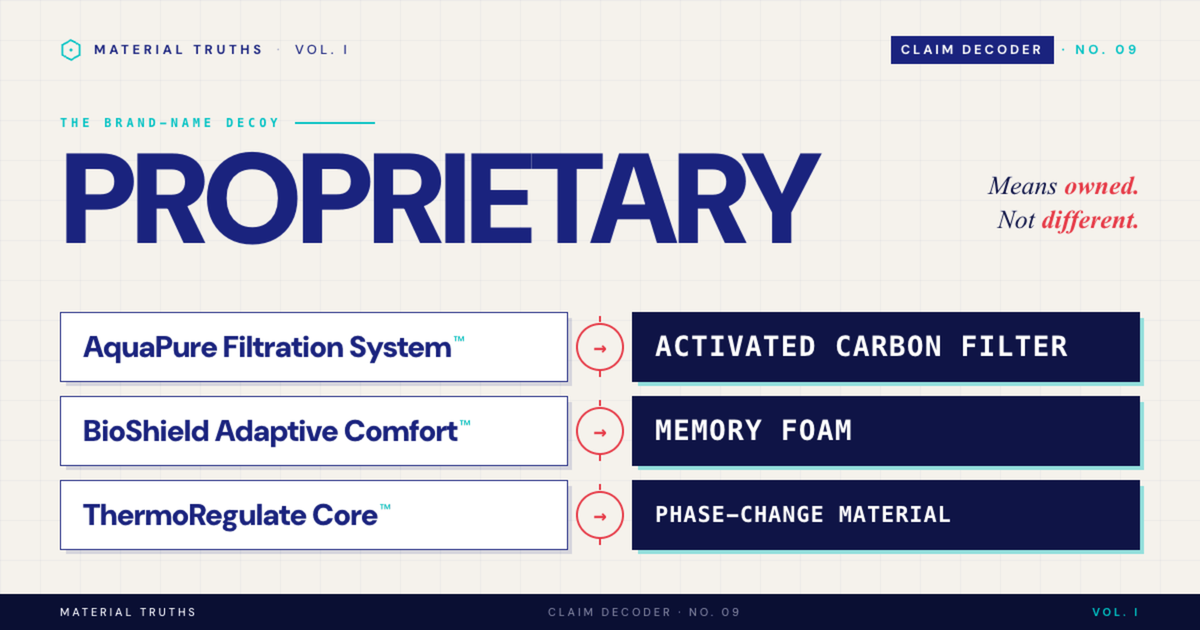
"Proprietary" means owned. It does not mean patented, trade-secret protected, or technologically distinctive. The term has no specific legal definition for consumer products, which means brands can apply it to almost anything they consider their own — including commodity technologies branded with trademarked names. Understanding where "proprietary" overlaps with actual legal protections (and where it doesn't) is the key verification skill.
What does "proprietary" actually mean?
In the narrowest sense, "proprietary" means owned. A company claims that something — a technology, a formula, a process, a blend — is its own. The ownership claim itself doesn't require any external verification. A company can label anything proprietary without filing anything, submitting anything to regulators, or meeting any specific standard.
This is fundamentally different from the legal frameworks that "proprietary" is often confused with:
Patents. Granted by USPTO after substantive examination. Specific patent numbers. 20 years of exclusive rights. Public verification through patent databases. Enforceable against competitors.
Trademarks. Registered with USPTO. Protect brand names and logos. Searchable at tsdr.uspto.gov. Enforceable against competitors using similar marks.
Trade secrets. Protected under the Defend Trade Secrets Act of 2016 and state laws. Require three elements: information is actually kept secret, commercial value derives from the secrecy, reasonable measures are taken to maintain secrecy. Not registered anywhere — protection comes from the fact of secrecy itself.
Copyrights. Registered with the Copyright Office. Protect creative works. Enforceable against copying.
"Proprietary" is not any of these. It's a descriptive term that often implies one or more of them without meeting their standards.
Common "proprietary" claims in consumer products
The term appears across categories with varying legitimacy:
| Claim | When it's legitimate | When it's deceptive |
|---|---|---|
| Proprietary technology | Novel, patented or genuinely differentiated | Trademarked name for commodity materials |
| Proprietary formula | Genuine unique formulation | Commodity ingredients with a branded name |
| Proprietary process | Documented unique manufacturing method | Standard industry process with a brand name |
| Proprietary blend (supplements) | DSHEA-compliant labeling format | Under-dosed ingredients hidden in combined weight |
| Proprietary materials | Custom-developed materials | Rebranded commodity fabric or components |
| Proprietary algorithm | Actual unique software or process | Marketing language for standard approaches |
The distinction is almost always: does underlying novelty exist, or is "proprietary" functioning as a branding technique for commodity offerings?
How does "proprietary" overlap with sciencewashing?
Our sciencewashing reference page documents the broader pattern. "Proprietary" claims are one of the most common sciencewashing tactics because they combine:
- An implication of technological distinctiveness
- An absence of disclosure requirements
- The perceived credibility of intellectual property protection
A brand that genuinely holds a patent typically references the patent by number. A brand that genuinely maintains a trade secret typically has specific elements to point to (custom equipment, unique supplier relationships, specific documented processes). A brand using "proprietary" as a standalone claim is often leveraging the term's ambiguity without any underlying substance.
Material Truths investigations consistently document this pattern in:
- Bedding and textile products (proprietary cooling technologies that are standard polyester)
- Skincare (proprietary peptide complexes that are commodity active ingredients)
- Supplements (proprietary blends under-dosing expensive ingredients)
- Consumer electronics (proprietary audio technologies licensing third-party patents)
Proprietary vs. patent — the critical distinction
Because the confusion between these terms is so fundamental, it's worth restating clearly:
Patent: Government-granted monopoly with specific patent number. Verifiable. Limited to 20 years. Specific claims define exactly what is protected.
Proprietary: Marketing term meaning owned. No specific definition. No verification. No time limit. No specific claims define what is covered.
A brand saying "our proprietary technology" without a patent number is not saying it's patented. Consumers often interpret it that way, which is the marketing value. But "proprietary" alone guarantees nothing.
When a brand says "our patented proprietary technology," check for the patent number. If no patent number is provided and none can be found at USPTO, the claim is not substantiated. See our claim decoder: Patented for the verification workflow.
Proprietary vs. trade secret
Trade secrets deserve specific treatment because they can legitimately protect information that isn't patented.
The Defend Trade Secrets Act of 2016 (18 U.S.C. §§ 1831-1839) and state trade secret laws protect information that:
- Is actually kept confidential
- Has commercial value from being kept confidential
- Is subject to reasonable efforts to maintain confidentiality
Trade secrets don't expire and don't require registration. They offer different protection than patents — weaker in that reverse engineering is permitted, stronger in that protection is unlimited in time.
Legitimate trade secret claims in consumer products:
- Coca-Cola's recipe (famously protected as a trade secret)
- KFC's 11 herbs and spices
- Specific custom equipment configurations
- Unique supplier relationships and sourcing methods
For consumer products claiming "proprietary," trade secret protection may or may not be the underlying reality. A brand can clarify by describing what makes the technology genuinely unique without revealing the secret itself. Brands unable to provide even high-level differentiation typically have no underlying trade secret.
How to verify "proprietary" claims
A four-step workflow:
Step 1: Look for a patent reference. If the brand claims proprietary technology is patented, verify the patent number at patents.uspto.gov or patents.google.com. See claim decoder: Patented.
Step 2: Look for a trademark reference. If the proprietary claim references a trademarked name (ThermaCool™, NanoActive®), the trademark protects only the name. The underlying technology may be commodity. Search tsdr.uspto.gov.
Step 3: Reverse image search the product. If the product appears identical to products from other brands on AliExpress, Alibaba, or Temu, the "proprietary" claim is marketing over commodity. See our drop shipping scam page for verification workflow.
Step 4: Ask for specificity. Brands with genuine proprietary technology can typically describe — at a high level that doesn't violate their own confidentiality — what makes their technology distinctive. Brands unable to provide specificity are using the term as pure branding.
When "proprietary" crosses into deception
FTC Act Section 5 and state consumer protection laws treat as deceptive any claim — including "proprietary" — that creates a false impression in the mind of a reasonable consumer. The word itself isn't regulated, but the overall impression it conveys is.
Specific patterns that typically cross into deception:
- "Proprietary patented technology" where no patent exists
- "Proprietary formula" where the formulation is commodity
- "Proprietary cooling technology" where the technology is standard polyester or moisture-wicking fabric
- "Proprietary manufacturing process" where the process is standard industry practice
Class actions under California CLRA and similar state statutes have successfully challenged these patterns, particularly when combined with premium pricing that the proprietary claim helps justify.
Frequently asked questions
What does "proprietary" mean on a product? The company owns it. No specific legal standard required.
Is it the same as "patented" or "trade secret"? No. Both have specific legal requirements; proprietary has none.
Common proprietary claims? Technology, formula, blend (specifically in supplements), process, materials, algorithm.
How can consumers verify? Look for patent references, trademark filings, reverse image search, request specificity from the brand.
What's a "proprietary blend" specifically? Supplement labeling format under DSHEA; see our proprietary blend reference page.
When does "proprietary" become deception? When it implies specific legal protection that doesn't exist or technological distinctiveness for commodity products.
Further reading
- Proprietary Blend: The specific supplement-labeling pattern
- Patent vs. Trademark: Foundational distinction
- Claim decoder: "Patented": Verification workflow
- Sciencewashing: Broader deception pattern
Sources
- Defend Trade Secrets Act of 2016, 18 U.S.C. §§ 1831-1839.
- DSHEA (Dietary Supplement Health and Education Act of 1994), Public Law 103-417.
- FDA. 21 CFR 101.36 — Nutrition labeling of dietary supplements.
- USPTO Patent Full-Text Database. patents.uspto.gov
- USPTO Trademark Status and Document Retrieval. tsdr.uspto.gov
- FTC Act Section 5, 15 U.S.C. § 45.