What "Natural Fragrance" Actually Contains (Often 50+ Undisclosed Ingredients)

Last updated: May 25, 2026
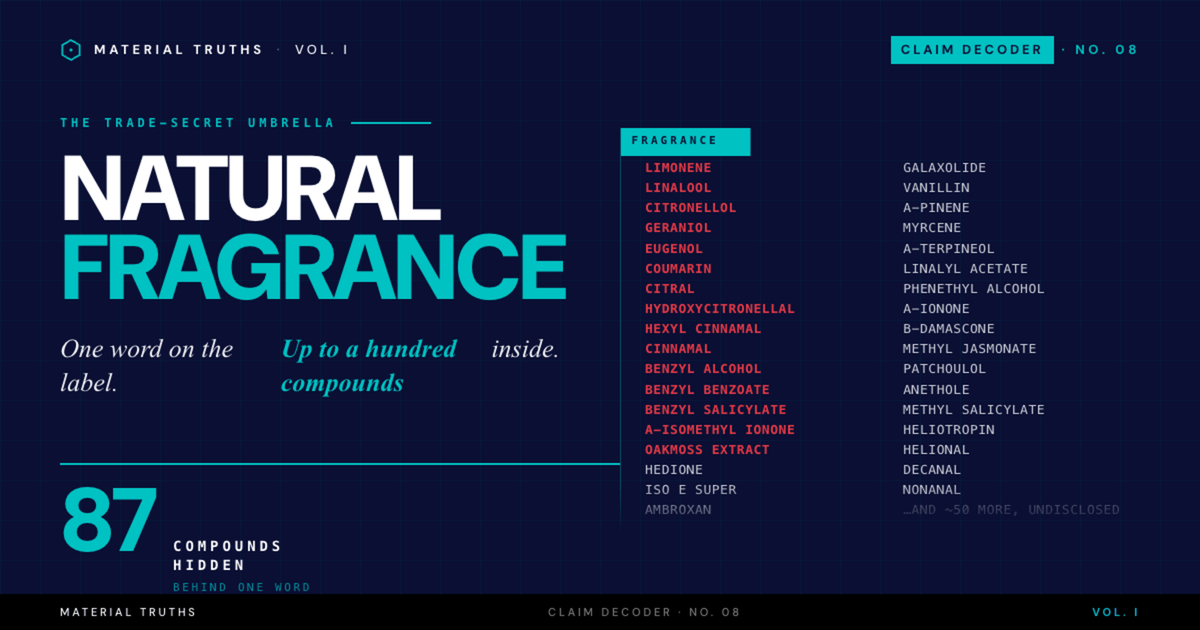
"Fragrance" as listed on a cosmetic ingredient label is a legal umbrella that can cover 50 to 100 or more individual chemical compounds, protected under FDA trade secret provisions. "Natural fragrance" combines this umbrella with an unregulated "natural" modifier — brands can apply the label regardless of whether synthetic compounds are present. The EU requires disclosure of 26 named fragrance allergens; the U.S. does not have an equivalent rule. California's SB 312 (2020) adds some state-level disclosure, and the federal Modernization of Cosmetics Regulation Act (MoCRA, 2022) has begun expanding transparency, but the core disclosure gap remains.
What does "fragrance" actually mean on a label?
Under FDA cosmetic labeling regulations (21 CFR 701.3) and the Fair Packaging and Labeling Act, cosmetics must list ingredients in descending order of predominance. However, fragrance ingredients receive a specific exemption: the mixture of chemicals that creates a scent can appear as a single "fragrance" or "parfum" entry rather than requiring disclosure of individual components.
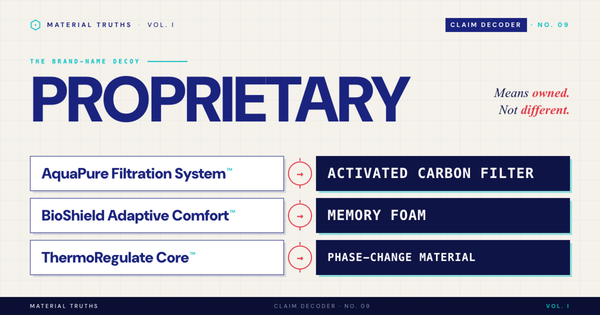
The rationale is trade secret protection. Fragrance formulations are considered proprietary because small variations in composition produce the distinctive scents that differentiate brands. Disclosing the full formulation would, in principle, allow competitors to replicate it.
In practice, this single-entry permission means:
- A "fragrance" ingredient can contain 50-100 or more individual compounds
- Allergens including phthalates, synthetic musks, and known sensitizers may be present without disclosure
- Consumers with specific chemical sensitivities cannot evaluate products based on ingredient lists
- Independent testing is often the only way to identify what "fragrance" actually contains
The gap between what the label shows and what the product contains has made fragrance disclosure a focus of consumer advocacy and some state-level regulatory action.
Is "natural fragrance" regulated?
No. Neither "natural" nor "fragrance" has a specific FDA definition for cosmetics. Combined, "natural fragrance" is an unregulated modifier on an already-undefined category.
Related terms with similar status:
- "Natural." Not defined in FDA cosmetic regulations. USDA's National Organic Program regulates "organic" for food but not cosmetics generally.
- "Essential oil." Has technical meaning — volatile aromatic compounds extracted from plants through distillation, expression, or similar processes. Quality and purity vary widely.
- "Fragrance oil." Broader term for synthetic or synthetic-natural blends.
- "Plant-based." No FDA definition.
- "Botanical." No FDA definition beyond general descriptions.
"Natural fragrance" is therefore compatible with formulations that include:
- Pure essential oils only
- Natural isolates (single compounds extracted from natural sources)
- Blends of natural and synthetic compounds
- Synthetic compounds that nature-identical to natural ones
- Entirely synthetic compounds marketed as "nature-inspired"
Without additional disclosure, consumers cannot determine which combination applies.
Why allergen disclosure matters
Fragrance mixtures are the leading cause of contact allergic reactions to cosmetics. The scientific literature identifies specific compounds — linalool, limonene, citronellol, geraniol, cinnamal, and others — that cause reactions in significant portions of the population, particularly when oxidized.
The European Union responded with mandatory disclosure. EU Cosmetics Regulation 1223/2009 requires that 26 named fragrance allergens be specifically listed on cosmetic labels when they exceed threshold concentrations (0.001% for leave-on products, 0.01% for rinse-off). This means EU consumers with fragrance allergies can identify potential triggers by reading labels.
The U.S. has no equivalent federal rule. Products sold in both markets typically have more informative EU labels than U.S. labels for the same product. This creates a notable regulatory asymmetry.
What U.S. regulations do exist?
Several partial frameworks apply:
California SB 312 (Cosmetic Fragrance and Flavor Ingredient Right to Know Act of 2020). Requires manufacturers to disclose certain designated fragrance and flavor ingredients in cosmetic products sold in California. Covered chemicals include those listed on authoritative lists of reproductive toxicants, carcinogens, and known sensitizers. Narrower than EU rules but meaningful for California-market products.
FDA Modernization of Cosmetics Regulation Act (MoCRA, 2022). The first major update to federal cosmetic regulation since 1938. Includes facility registration, adverse event reporting, and some fragrance allergen requirements still being implemented. Full implementation extends through 2025-2026. MoCRA does give FDA authority to establish fragrance allergen disclosure requirements, but specific rules are still being developed.
International Fragrance Association (IFRA) standards. Voluntary industry guidelines on fragrance safety. Some brands commit to IFRA standards voluntarily; the framework is not government-enforced in the U.S.
California Proposition 65. Requires warnings for products containing listed chemicals. Some fragrance compounds are listed, creating disclosure obligations for products containing them in significant quantities.
"Fragrance-free" vs. "unscented" — also unregulated
Both terms sound similar but can mean different things in practice:
"Fragrance-free." Generally means no added fragrance for aesthetic purposes. The product may still contain ingredients with incidental aromatic qualities, or compounds added to mask other odors.
"Unscented." Often contains masking fragrance — compounds specifically designed to neutralize the natural smell of other ingredients. Technically the product has added fragrance, but the intent is odorlessness rather than scent.
Neither term is FDA-defined. A product genuinely free of all fragrance compounds — aromatic ingredients, masking agents, incidentally aromatic materials — is rare and usually labeled with more specific language.
For fragrance-allergic consumers, "fragrance-free" is usually safer than "unscented" but neither guarantees absence of reactive compounds.
How can consumers verify fragrance claims?
Practical approaches:
1. Look for specific ingredient disclosure. Brands committed to transparency voluntarily list individual fragrance components on their websites or in detailed ingredient lists. Absence of specific disclosure signals reliance on the umbrella "fragrance" category.
2. Use EWG Skin Deep (ewg.org/skindeep). Environmental Working Group's database evaluates cosmetic ingredients against published safety assessments. Products with undisclosed fragrance components typically receive lower transparency ratings.
3. Check for certifications that address fragrances:
- Made Safe (madesafe.org) — evaluates specific chemical concerns including fragrance allergens
- EWG Verified — requires ingredient disclosure meeting EWG standards
- Credo Clean Standard — retailer-level ingredient screening
4. Check California Right to Know compliance. California SB 312 requires disclosure of specific chemicals; products complying with California rules often provide more information than minimum federal requirements demand.
5. Compare U.S. and EU labels when available. The same product often has more complete ingredient disclosure in EU markets. Ingredients listed only on EU labels are often present in U.S. versions as well.
6. Search for specific allergens. If you have a known fragrance sensitivity, request disclosure from the brand directly. Brands without public disclosure may still provide specific information on request.
Frequently asked questions
What does "fragrance" on a label legally mean? A single ingredient entry that can contain 50-100 or more undisclosed compounds, permitted under trade secret provisions.
Is "natural fragrance" regulated? No — neither "natural" nor "fragrance" has FDA definition for cosmetics.
What about allergen disclosure? EU requires disclosure of 26 named fragrance allergens; U.S. has no equivalent federal rule. California SB 312 and MoCRA provide partial U.S. disclosure.
Difference between "natural," "essential oil," "fragrance oil"? Essential oil has technical meaning (plant-extracted aromatic compounds); fragrance oil is broader (synthetic or blended); "natural" is undefined.
Can "fragrance-free" products contain fragrance? Yes — may contain masking agents or incidentally aromatic ingredients. "Unscented" often contains masking fragrance.
How can consumers verify? EWG Skin Deep, Made Safe certification, California disclosure, brand-specific transparency programs.
Further reading
- Greenwashing: Broader pattern where "natural" claims appear
- Claim decoder: "Non-Toxic": Adjacent unregulated chemical claim
- Claim decoder: "Eco-Friendly": Related general environmental claim
- Claim decoder: "Hypoallergenic": Related unregulated safety term
Sources
- FDA. 21 CFR 701.3 — Designation of ingredients.
- Fair Packaging and Labeling Act, 15 U.S.C. §§ 1451-1461.
- EU Cosmetics Regulation 1223/2009, Annex III.
- California Cosmetic Fragrance and Flavor Ingredient Right to Know Act of 2020 (SB 312).
- Modernization of Cosmetics Regulation Act of 2022 (MoCRA).
- International Fragrance Association. "IFRA Standards." ifrafragrance.org
- EWG Skin Deep. ewg.org/skindeep