Astroturfing: Fake Grassroots Marketing, How to Spot It, and What the FTC Says

Last updated: April 25, 2026
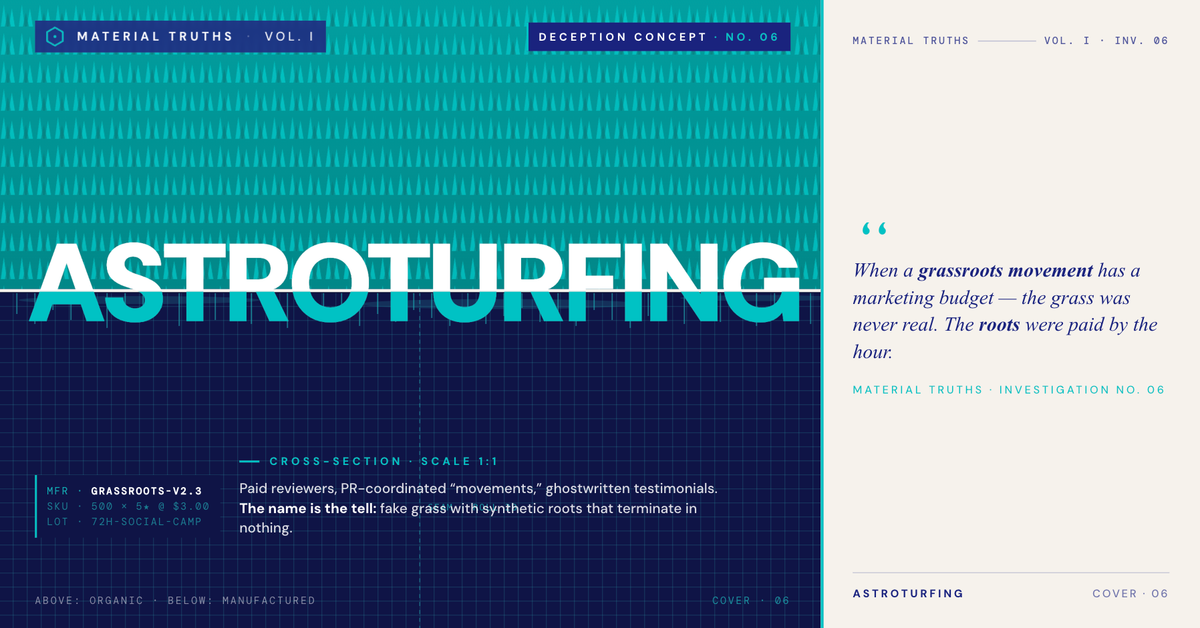
Astroturfing is marketing that disguises brand-sponsored messaging as independent consumer enthusiasm or grassroots support. The name comes from AstroTurf — artificial grass that simulates the real thing. In consumer products, astroturfing typically involves paid influencers without disclosure, employees posting as ordinary consumers, and manufactured social media movements designed to look organic. The FTC's 2023 update to its Endorsement Guides closed many historical loopholes, but astroturfing remains pervasive — particularly on TikTok Shop, Instagram, and Reddit.
What is astroturfing?
The term describes the fabrication of apparent grassroots support for a product, idea, or position. Whereas traditional advertising is transparent about its commercial nature — the consumer knows they are being marketed to — astroturfing operates through concealment. The effectiveness depends on the consumer believing that praise, endorsement, or advocacy is coming from independent sources.
In the consumer product context, astroturfing takes five primary forms:
1. Undisclosed paid influencer content. An influencer posts what appears to be personal discovery and recommendation of a product, without disclosing that the brand paid them (or provided free product in exchange for the post). The FTC's Endorsement Guides require disclosure of material connections.
2. Employee endorsements posing as consumer endorsements. Brand employees post reviews, social media content, or forum comments praising their employer's products without disclosing the employment relationship. Sometimes called "shilling."
3. Seeded forum and community posts. Reddit, Quora, Trustpilot, and specialized forums (skincare subreddits, bedding review communities, fitness groups) become targets for seeded content where marketing agencies pay members or create accounts to insert brand mentions disguised as authentic recommendations.
4. Fabricated consumer advocacy organizations. Organizations with names like "Consumer Alliance for [Industry]" or "Consumers for Natural Products" that appear to be grassroots advocacy groups but are funded and operated by industry.
5. Bot-amplified or purchased engagement. Hashtag campaigns, retweet/repost waves, and viral-seeming movements that are manufactured through paid engagement services rather than organic consumer action.
Astroturfing is distinct from ordinary marketing in one critical dimension: the consumer does not know they are being marketed to. That asymmetry is what makes it deceptive and what makes it regulated.
How is astroturfing different from traditional advertising?
The difference is transparency.
A television commercial, a display ad, a sponsored Instagram post clearly labeled as an ad, a paid affiliate link disclosed as such — these are all marketing. The consumer is aware they are being targeted, can evaluate the message with appropriate skepticism, and can choose to ignore it. Regulatory frameworks around advertising apply.
Astroturfing removes the transparency. A TikTok creator praising a skincare product on their "personal" account without disclosing brand payment. A Reddit poster recommending a specific bedding brand "they just discovered." A company's employee writing glowing Trustpilot reviews under consumer aliases. In each case, the consumer interprets the message as independent endorsement and adjusts their purchase decision based on that misreading.
The FTC's formal position: any material connection between an endorser and a brand must be clearly and conspicuously disclosed. The phrase "material connection" covers any relationship — payment, free product, employment, familial connection, business relationship — that might reasonably affect the weight consumers give to the endorsement.
What are the most common astroturfing tactics?
Five tactics account for the majority of astroturfing in consumer products:
Undisclosed paid influencer content. Brands pay influencers ranging from micro-influencers ($50-500 per post) to major figures (hundreds of thousands per post) for endorsements. The FTC requires clear disclosure — typically #ad, #sponsored, or equivalent — at the start of the content, in a way that cannot be missed.
Influencer whitelisting. A brand uses influencer content as the creative for its own paid advertising, presenting what was originally an "organic" endorsement as a brand ad. The line between sponsored content and astroturfing can blur when the influencer's original post was itself paid and the brand reuses it without maintaining disclosure standards.
Seeded review communities. Paid posts in subreddits, Facebook groups, Trustpilot, and Reddit communities from accounts that appear to be ordinary users. These posts typically have a specific template: a "discovery" narrative, specific brand mentions, enthusiastic but slightly generic praise. The FTC's review rule addresses some of this, but the astroturfing overlap is substantial.
Fake consumer advocacy organizations. Particularly common in supplements, food, and environmental categories. Organizations with legitimate-sounding names and websites that take industry funding and promote specific brands or industry positions while presenting as consumer-side.
Manufactured engagement campaigns. Hashtag movements, coordinated posts, and viral-seeming content where the underlying engagement is purchased rather than organic. Services that sell Twitter/X engagement, Instagram engagement, and TikTok comments support this ecosystem.
How does the FTC regulate astroturfing?
The FTC's Guides Concerning the Use of Endorsements and Testimonials in Advertising, updated in June 2023 and located at 16 CFR Part 255, are the primary federal framework.
Core requirements:
1. Disclosure of material connections. Any material connection between an endorser and a brand must be clearly and conspicuously disclosed. This includes payment, free products, affiliate commissions, employment, and family relationships. Disclosures must be understandable, placed where consumers will see them, and made before the endorsement is consumed.
2. Clear and conspicuous standard. Disclosures must not be buried in hashtag chains, placed only in bios, used in foreign language or obscure abbreviations, or positioned where consumers will likely miss them. #ad at the beginning of a caption meets the standard; #spon buried on line 8 of 12 hashtags does not.
3. Truthful endorsement. An endorsement must reflect the endorser's honest opinion, and the endorsed claims must be substantiated by the brand. A paid influencer claiming a skincare product "cured" their eczema creates brand liability even with disclosure, because the underlying claim must be substantiated.
4. Platform built-in disclosures. The FTC allows use of platform-specific disclosure tools (Instagram's "paid partnership" tag, YouTube's "includes paid promotion" label) but requires that they be visible and clear. Tools that are too faint or easily missed do not satisfy the disclosure requirement.
5. Liability scope. Brands, agencies, and endorsers can all be held liable. An agency that facilitates undisclosed influencer partnerships, a brand that fails to monitor its influencer contracts for disclosure compliance, and the influencer themselves can each face enforcement.
How can consumers spot astroturfing?
Practical indicators:
1. Praise without personal context. Genuine enthusiasts typically describe specific use cases and personal circumstances. Astroturf praise often reads like a condensed brand talking point.
2. Account history mismatch. A Reddit or Instagram account focused entirely on praising products in one category, without the mixed content typical of genuine users.
3. Identical messaging across accounts. When multiple "independent" voices use similar phrasing, the similarity is usually not coincidental.
4. Sudden hashtag campaigns. Movements that appear fully formed overnight, with high early engagement that doesn't sustain, often indicate manufactured amplification.
5. Advocacy group funding opacity. Legitimate consumer advocacy organizations disclose funding sources. Industry-front groups typically use vague "member-supported" language that obscures corporate backing.
6. Disclosure absence on clearly promotional content. TikTok and Instagram content that is visually and structurally indistinguishable from sponsored content but lacks #ad or "Paid Partnership" tags.
7. Brand mention patterns on Reddit and forums. Sudden appearance of brand mentions in a community, often from accounts created recently, frequently indicates seeded content.
Recent enforcement actions on astroturfing
The FTC has pursued notable cases:
- Lord & Taylor (2016): Settled FTC charges that it paid 50 fashion influencers to post Instagram photos wearing an identical paisley dress without disclosing the paid relationship.
- Machinima (2015): Paid YouTube gaming influencers for positive Microsoft Xbox One videos without disclosure.
- Warner Bros (2016): Paid YouTube influencers for positive coverage of a video game release.
- CSGO Lotto (2017): Influencers owned and promoted the gambling service without disclosing ownership.
- Teami (2020): Influencers promoted wellness products with unsubstantiated health claims; the brand and influencers both faced FTC action.
Class actions on undisclosed sponsorships have multiplied through 2023-2026, particularly as creator economy enforcement has intensified.
This section is updated as new enforcement actions are documented.
Frequently asked questions
What is astroturfing? Marketing that disguises brand-sponsored messaging as independent consumer support or grassroots enthusiasm.
How is astroturfing different from traditional advertising? Traditional advertising is transparent about its commercial nature; astroturfing works through concealment.
What are the most common astroturfing tactics? Undisclosed paid influencer content, employee endorsements, seeded forum posts, fake consumer advocacy groups, and manufactured engagement campaigns.
How does the FTC regulate astroturfing? Through the Endorsement Guides at 16 CFR Part 255, requiring clear disclosure of material connections between endorsers and brands.
How can consumers spot astroturfing? Praise without personal context, account history mismatch, identical messaging, sudden hashtag campaigns, advocacy group funding opacity, and missing disclosures on promotional content.
Recent enforcement? Lord & Taylor, Machinima, Warner Bros, CSGO Lotto, Teami, plus expanding class action litigation.
Further reading
- Fake Reviews: Adjacent manipulation often combined with astroturfing
- Sciencewashing: Broader deception pattern
- FTC Consent Order: What happens when enforcement resolves
Sources
- FTC. "Guides Concerning the Use of Endorsements and Testimonials in Advertising." 16 CFR Part 255 (updated June 2023). ftc.gov
- FTC. "The FTC's Endorsement Guides: What People Are Asking." Business guidance. ftc.gov
- Federal Trade Commission press releases on Lord & Taylor, Machinima, Warner Bros, CSGO Lotto, Teami enforcement actions.
Get notified when we add new enforcement examples to this page.