What Is an FTC Consent Order? What It Means When a Brand Signs One

Last updated: May 3, 2026
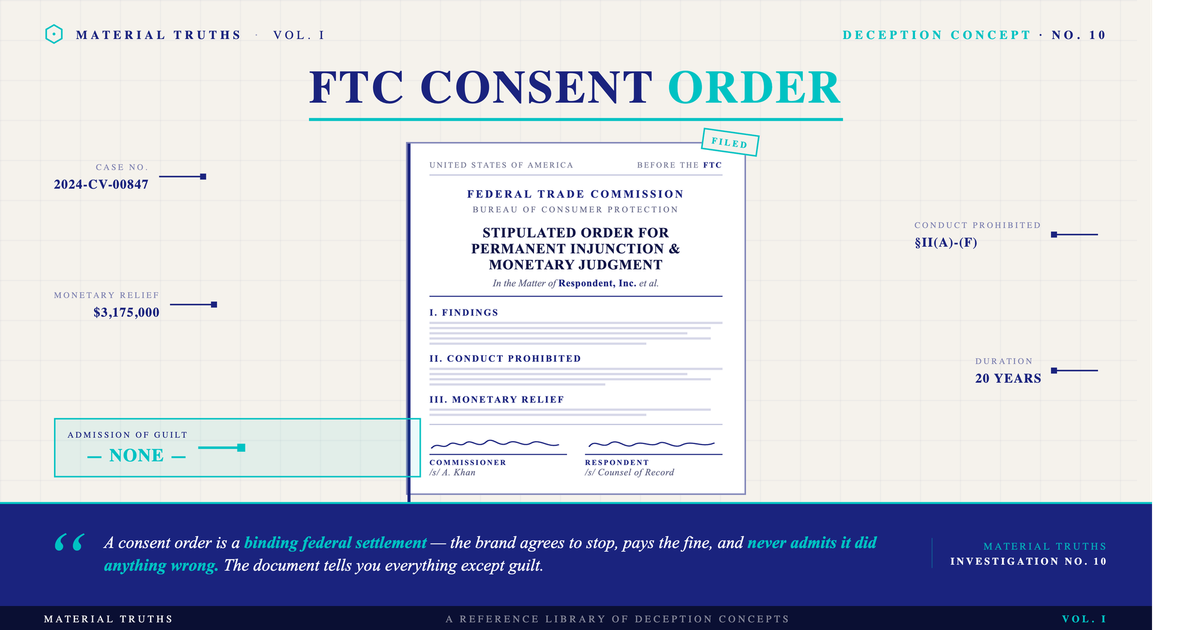
An FTC consent order is a binding settlement between the Federal Trade Commission and a company that resolves an enforcement action without the company admitting wrongdoing. The respondent agrees to specific conduct changes: prohibitions on future deception, monetary penalties, consumer redress, and reporting obligations. Violations of the order can trigger civil penalties of up to $53,088 per violation. Consent orders are the most common outcome of FTC enforcement and typically remain in force for 10 to 20 years, making them a critical tool for ongoing accountability.
What is an FTC consent order?
When the FTC investigates a company for deceptive or unfair practices, the case can resolve in several ways. Litigation to judgment is rare — most cases are resolved through negotiated settlement. The settlement document that memorializes the resolution is typically called a "consent order" or "stipulated order."
A consent order contains several standard elements:
1. Factual background. A statement of the allegations the FTC made and the conduct at issue, written in a way the respondent accepts even without admitting the allegations are true.
2. Specific conduct prohibitions. The respondent agrees not to engage in specified future conduct — for example, not making unsubstantiated health claims, not claiming U.S. origin without meeting the "all or virtually all" standard, not using fake reviews.
3. Monetary relief. Either civil penalties paid to the FTC, consumer redress paid to affected customers, or disgorgement of profits from the challenged conduct. Amounts range from thousands to hundreds of millions depending on case severity.
4. Compliance obligations. Record-keeping requirements, reporting obligations, cooperation with FTC monitoring, and designation of compliance officers.
5. Duration. Typically 10 to 20 years, during which the order remains enforceable.
6. No admission of liability. Standard language stating the respondent does not admit any law violation. This allows the company to settle without creating admissions that could be used in parallel litigation.
7. Enforcement provisions. Consent orders carry the full force of federal court orders. Violations can trigger civil penalties, contempt proceedings, and additional FTC enforcement.
How is a consent order different from a court ruling?
A court ruling is a judicial determination on the merits — a judge or jury evaluates evidence and decides whether a party violated the law. A consent order is a settlement in which neither side adjudicates the merits. The parties agree to terms, and the court approves the settlement without ruling on whether the conduct was illegal.
Key differences:
| Dimension | Court Ruling | Consent Order |
|---|---|---|
| Merits decided | Yes | No |
| Admission of wrongdoing | Yes, if found liable | No |
| Precedent value | Strong | Limited |
| Speed | Months to years | Weeks to months |
| Cost | Very high | Modest |
| Public record | Yes | Yes |
| Enforceable as court order | Yes | Yes |
| Settlement discount | None | Often significant |
Consent orders are the standard resolution because both sides typically prefer the certainty and speed over the cost and risk of litigation. The FTC conserves enforcement resources. The respondent caps liability exposure.
What penalties apply for violating a consent order?
Consent order violations are particularly serious. Under FTC Act Section 5(l), each violation can trigger civil penalties up to $53,088 (2025 adjustment).
The penalty amounts become substantial because:
- Per-violation counting. Each individual deceptive act can be a separate violation. A single product line with 10,000 units sold with non-compliant labels could theoretically trigger 10,000 separate violations.
- Individual executive liability. Consent orders often name individual executives; personal liability attaches.
- Civil contempt exposure. Violating a court order can trigger contempt proceedings in addition to civil penalties.
- Reputational damage. Repeat offender status materially affects future FTC enforcement, class action litigation posture, and brand credibility.
Illustrative recent enforcement:
Williams-Sonoma (April 2024) — $3.175 million. The home goods retailer paid the largest civil penalty in Made in USA Labeling Rule history specifically because it violated a prior 2020 FTC consent order on Made in USA claims. The underlying conduct (false origin claims) might have drawn a smaller penalty in a first-offense case, but the consent order violation elevated consequences.
Kubota (January 2024) — $2 million. Tractor manufacturer paid the first major civil penalty under the Made in USA Labeling Rule for false claims on replacement parts, resolved via consent order.
TouchTunes Music Company (April 2026) — $625,000 in consumer redress. As part of the FTC's April 2026 Made in USA enforcement sweep, TouchTunes agreed to the largest redress amount for a Made in USA Labeling Rule case to date, along with prohibitions on future misrepresentations.
The Williams-Sonoma example particularly illustrates how consent orders shape subsequent enforcement. The company had resolved prior allegations in 2020 through a consent order prohibiting specific future conduct. When the FTC determined the same conduct recurred, the consent order violation produced a higher penalty than the original case had.
How can consumers find consent orders on a brand?
The FTC makes case information public through several portals:
1. FTC case and enforcement library. Located at ftc.gov/legal-library/browse/cases-proceedings. Search by company name, case number, or topic. Each listing typically includes the original FTC complaint document, the consent order or stipulated judgment, related press releases, and post-settlement compliance filings.
2. FTC press release archive. Located at ftc.gov/news-events/news/press-releases. Press releases announcing enforcement actions include links to the underlying documents and often provide plain-English summaries of the conduct and remedy.
3. PACER (federal court filings). Located at pacer.uscourts.gov. FTC consent orders filed in federal court are searchable by case number. Requires modest per-page fees but provides the most complete filings.
4. Topic-specific FTC pages. The FTC publishes dedicated pages for major enforcement topics — Made in USA (ftc.gov/news-events/topics/tools-consumers/made-usa), Fake Reviews, Health Claims — that chronologically list enforcement actions within each category.
Verification workflow for any brand:
- Search the brand name at ftc.gov/legal-library/browse/cases-proceedings
- If results appear, read the consent order to understand what conduct was prohibited
- Check whether the order is still in force (typically 10-20 years from execution)
- Evaluate whether current brand practices appear to match the prohibited conduct
Recent high-profile consent orders
Recent cases illustrating the range of FTC consent orders:
| Year | Brand | Conduct | Settlement |
|---|---|---|---|
| 2026 (Apr) | TouchTunes Music | False Made in USA claims | $625K consumer redress |
| 2026 (Apr) | Americana Liberty / Three Nations | False Made in USA claims on flag products | Consent order, no financial penalty disclosed |
| 2026 (Apr) | Oak Street Manufacturing | "Handcrafted 100%" claims on footwear with foreign components | Consent order |
| 2024 (Apr) | Williams-Sonoma | Repeat Made in USA violation | $3.175M civil penalty |
| 2024 (Jan) | Kubota | False Made in USA replacement parts claims | $2M civil penalty |
| 2022 (May) | Lions Not Sheep | Made in USA labels on Chinese imports | Individual and corporate liability |
| 2020 (Jul) | Williams-Sonoma (first action) | Made in USA claims | Consent order (violated in 2024) |
Each case has a public docket on FTC.gov with the complaint, consent order, and related documents available for download.
Does a consent order mean a brand admitted guilt?
No. Consent orders typically include language stating that the respondent does not admit any law violation. The order resolves the case without adjudication.
However, consumers should treat a consent order as strong circumstantial evidence of the underlying allegations for three reasons:
1. The FTC does not settle without substantive basis. The Commission has limited enforcement resources and targets cases where it has credible evidence. Settlement indicates the Commission believed the case would prevail if litigated.
2. The prohibitions in the order target the specific alleged conduct. If the consent order prohibits the brand from making specific claims, it's because the FTC alleged the brand was making those claims deceptively. The brand agreed not to do it going forward.
3. Settlement economics favor accepting orders when evidence is strong. Companies with strong defenses typically litigate. Companies that settle are making a rational economic judgment that settlement is less costly than likely loss at trial.
A consent order is not a formal finding of wrongdoing, but it is a documented decision by the brand to accept binding restrictions on its conduct in exchange for case resolution. Consumers can reasonably infer that the restrictions reflect real problems with the brand's past practices.
Frequently asked questions
What is an FTC consent order? A binding settlement between the FTC and a company that resolves an enforcement action without admission of wrongdoing, carrying force of law with penalties for violations.
How is a consent order different from a court ruling? Court rulings adjudicate the merits; consent orders resolve the case by negotiation without merits determination.
What penalties apply for violating a consent order? Up to $53,088 per violation, with each instance potentially a separate violation. Williams-Sonoma paid $3.175M for violating a prior order.
How can consumers find consent orders on a brand? Search ftc.gov/legal-library/browse/cases-proceedings or PACER at pacer.uscourts.gov.
Recent high-profile consent orders? Williams-Sonoma ($3.175M, 2024), Kubota ($2M, 2024), TouchTunes ($625K redress, 2026), among many others.
Does a consent order mean a brand admitted guilt? No, but it reflects substantive FTC concerns and binds the brand to specific conduct restrictions.
Further reading
- Made in USA: Topic area with most recent major consent orders
- Fake Reviews: FTC Consumer Reviews Rule enforcement produces consent orders
- Sciencewashing: Many health claim consent orders fit this pattern
- Astroturfing: Endorsement Guides cases typically resolved via consent order
Sources
- Federal Trade Commission Act, 15 U.S.C. § 45(l) — Civil penalty authority for consent order violations.
- FTC. "Legal Library: Cases and Proceedings." ftc.gov/legal-library/browse/cases-proceedings
- FTC. Press releases and case documents for Williams-Sonoma (April 2024), Kubota (January 2024), April 2026 enforcement sweep.
- PACER — Public Access to Court Electronic Records. pacer.uscourts.gov