Patent vs. Trademark: The Difference That Determines If a Product Claim Is Real

Last updated: April 21, 2026
A patent protects a novel invention; a trademark protects a name. Brands exploit the confusion between the two to imply technological innovation when they have registered only a name. The distinction is precise in law and free to verify, but the ambiguity is profitable for brands and persistent in marketing. Understanding the difference is the single most important verification skill for evaluating consumer product claims.
What's the difference between a patent and a trademark?
A patent and a trademark are both forms of intellectual property, but they protect fundamentally different things.
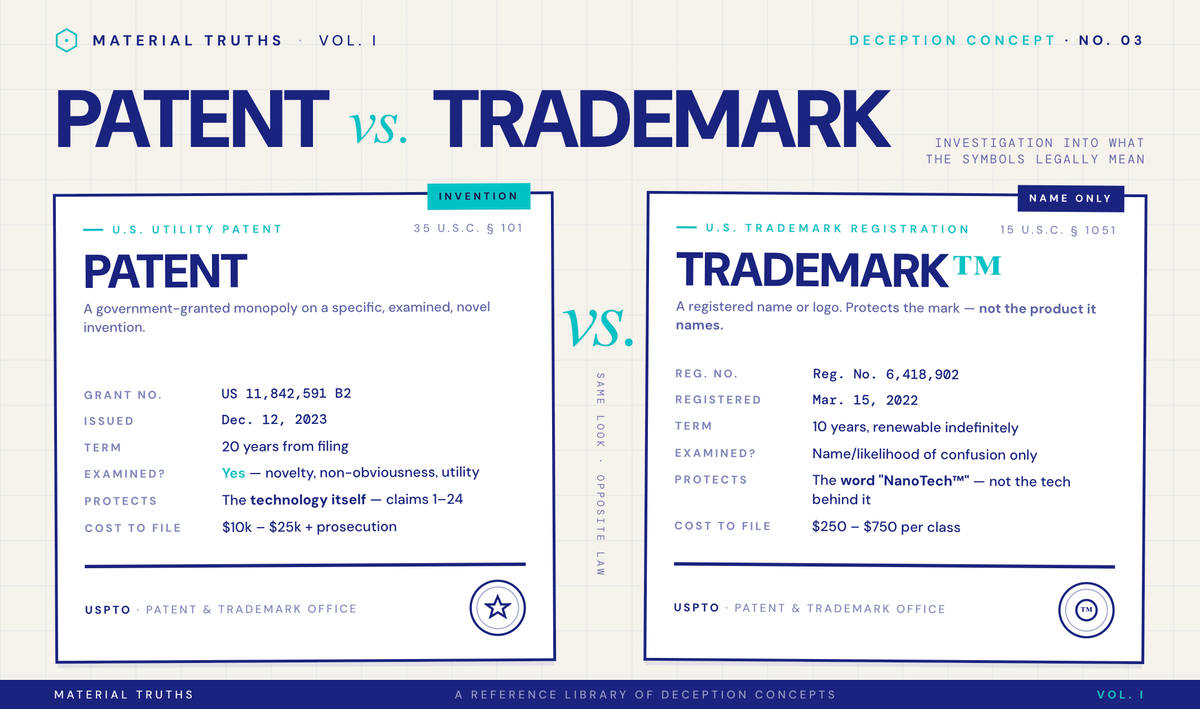
A patent protects a novel invention — a new product, a new process, a new technology, or a new composition of matter. To receive a patent, the applicant must demonstrate to the U.S. Patent and Trademark Office (USPTO) that the invention is new, non-obvious, and useful. The examination process is substantive: USPTO examiners compare the application against prior art to verify novelty. The process typically takes 18 to 36 months and costs between $8,000 and $20,000 in combined USPTO fees and attorney fees. A utility patent provides exclusive rights for 20 years from the filing date.
A trademark protects a brand name, logo, slogan, or other identifier that distinguishes one company's goods or services from another's. To register a trademark, the applicant must demonstrate only that the mark does not conflict with existing registered marks and that the mark is in use (or will be) in commerce. The examination process is comparative, not substantive — USPTO examiners check for conflicts, not for innovation. Federal trademark registration costs approximately $250 to $350 in filing fees, takes 8 to 12 months, and lasts as long as the mark remains in use.
The core difference: a patent is evidence of novel technology. A trademark is evidence only that a brand has registered a name.
What do the ™, ®, and Patent Pending symbols actually mean?
The symbols appear interchangeable to most consumers, but each has a precise meaning.
| Symbol | What it means | What it does NOT mean |
|---|---|---|
| ™ | An unregistered trademark claim. The brand asserts it considers this mark its trademark. | That the mark is registered. That the product has any IP protection beyond the name. |
| ® | A federally registered trademark. The mark is registered with the USPTO. | That the product has a patent. That the underlying technology is novel. |
| Patent Pending | A patent application has been filed with the USPTO. | That a patent will be granted. That any legal protection yet exists. |
| Pat. No. X,XXX,XXX | A specific issued U.S. patent number. Verifiable at USPTO.gov. | (Nothing — this is the only symbol that corresponds to an actual granted patent.) |
The symbol that signals a real, examined, issued patent is the one that appears least frequently on consumer packaging: an explicit patent number. Brands that hold real patents usually cite the patent number on packaging because patent numbers are evidence of genuine innovation. Brands that rely on ™ or ® to imply innovation are typically leveraging the ambiguity.
How much does a patent cost versus a trademark?
The cost gap is substantial and reveals why brands often register trademarks but not patents.
Patent costs (utility patent):
- USPTO filing fees: $320 (small entity: $160; micro entity: $80)
- Search and examination fees: $700 (small entity: $350)
- Issue fee: $1,000 (small entity: $500)
- Maintenance fees over 20 years: approximately $7,400 total
- Attorney fees: typically $5,000 to $15,000 for drafting and prosecution
- Total typical cost: $8,000 to $20,000
Trademark costs (federal registration):
- USPTO filing fee: $250 to $350 per class of goods (as of 2026 fee structure)
- Attorney fees: optional, typically $500 to $1,500 if used
- Renewal every 10 years: $425 to $525
- Total typical cost: $250 to $1,850
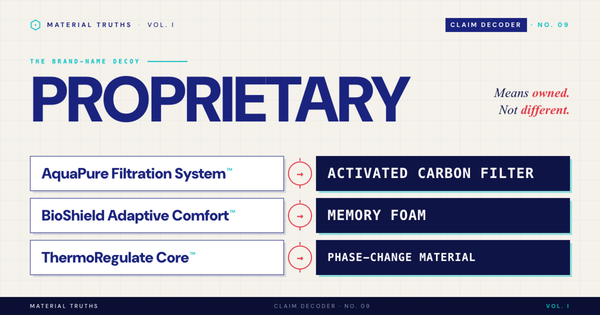
A company that trademarks "ThermaNano™" has spent a few hundred dollars. A company that patents a genuinely novel thermal regulation technology has spent tens of thousands and survived substantive examination. Consumer products frequently display the first and imply the second.
How can consumers verify patent claims?
Every issued U.S. patent is searchable in public databases at no cost. Two tools:
1. USPTO Patent Full-Text and Image Database (PatFT). Located at ppubs.uspto.gov (and the newer patents.uspto.gov interface). Search by patent number, assignee (the company that owns the patent), inventor name, or keyword. Results include the full patent document, claims, and prosecution history.
2. Google Patents. Located at patents.google.com. A more user-friendly interface that searches the same data. Includes international patents and allows searching by product keyword.
A practical verification workflow (5 minutes):
- Identify the specific patent claim the brand is making. Is it "patented technology"? "Patented formula"? "Patent pending"?
- Search Google Patents for the brand name as assignee.
- If no patents come up, search for the trademarked product name or the specific technology term.
- If the brand claims a patent number, verify it directly.
- If no verifiable patent exists, the "patented" claim is likely false.
If a brand claims a patented technology and no patent can be found, three possibilities exist: (a) the claim is false, (b) the patent is held by a third party the brand licenses from (which should be disclosed), or (c) the claim refers to a pending application that has not yet been granted. Only the third case is not actionable, and "patent pending" should never be described as a granted patent.
How can consumers verify trademark claims?
Trademarks are searchable in a separate USPTO database.
USPTO Trademark Status and Document Retrieval (TSDR). Located at tsdr.uspto.gov. Enter the trademark name or serial number to see registration status, goods and services covered, and ownership.
A trademark registration confirms only that the name is protected. It does not confirm the product's efficacy, quality, or technological novelty. The purpose of trademark registration is brand protection, not product validation.
Which consumer products commonly abuse this distinction?
The pattern appears most frequently in:
- Supplements and nutraceuticals: "Patented blend," "proprietary formula," or "patented delivery system" claims, most of which refer to trademarked names rather than patented technology
- Bedding and textiles: "Patented cooling technology," "patented cooling fabric," "patented heat dissipation" claims on products made with commodity polyester, nylon, or similar materials
- Skincare: "Patented peptide complex," "patented anti-aging formula" claims on products containing well-known ingredients at standard concentrations
- Consumer electronics: "Patented sound technology" claims that often reference actual licensed patents but exaggerate the licensed technology's contribution to the product's performance
Material Truths' investigations regularly document products in these categories where "patented" claims cannot be substantiated with any USPTO record. The pattern is consistent: trademark a distinctive name, imply it represents patented innovation, rely on consumer confusion.
Recent enforcement actions on false patent claims
The FTC and individual states bring false patent marking cases under 35 U.S.C. §292 and state consumer protection laws. Enforcement is inconsistent because the statute requires proving intent to deceive, but private lawsuits have produced notable settlements.
Private class actions have been particularly active. Courts have found that marketing a product as "patented" when no patent exists meets the standard for false advertising under state consumer protection laws even when the brand argues the term was used generally. California's Consumers Legal Remedies Act and New York General Business Law §349 have been primary vehicles for these cases.
This section is updated as new enforcement actions are documented.
Frequently asked questions
What's the difference between a patent and a trademark? A patent protects a novel invention for 20 years after substantive USPTO examination. A trademark protects a brand name only, with no innovation requirement. See the sections above for full detail.
Does a ® symbol mean a product is patented? No. ® indicates a registered trademark, which protects only the name.
How much does a patent cost? Typically $8,000 to $20,000 for a utility patent. Trademarks cost $250 to $1,850.
How can I check if a product is really patented? Search patents.google.com or ppubs.uspto.gov for the brand name or technology. If no patent appears, the claim is likely false.
What does "patent pending" actually mean? A patent application has been filed but not yet examined or granted. It provides no legal protection.
Can a company lie about having a patent? False patent marking is illegal under 35 U.S.C. §292, though enforcement is inconsistent. The FTC can also pursue false patent claims as deceptive advertising.
Further reading
- Sciencewashing: The broader pattern false patent claims fit into
- Proprietary Blend: How "proprietary" relates to "patented"
- Claims decoder: "Patented": The specific verification process
- Claims decoder: "Proprietary": The related marketing term
Sources
- U.S. Patent and Trademark Office. "General Information Concerning Patents." uspto.gov/patents/basics
- U.S. Patent and Trademark Office. "Trademark Basics." uspto.gov/trademarks/basics
- 35 U.S.C. §292 — False marking. law.cornell.edu/uscode/text/35/292
- USPTO Patent Full-Text Database. ppubs.uspto.gov
- Google Patents. patents.google.com
- USPTO Trademark Status and Document Retrieval. tsdr.uspto.gov
Get notified when we add new enforcement examples to this page.