Greenwashing: What It Is, What the FTC Green Guides Require, and How to Spot It

Last updated: April 25, 2026
Greenwashing is the practice of making misleading or unsubstantiated claims about the environmental benefits of a product, service, or company practice. It includes vague "eco-friendly" labels, fabricated certifications, unsubstantiated carbon-neutral claims, and imagery implying natural origins when products are synthetic. The FTC's Green Guides define what environmental claims legally require, and the EU's 2026 Greenwashing Directive establishes stricter European standards. Consumers encounter greenwashing most often in household products, apparel, packaging, and food.
What is greenwashing?
The term "greenwashing" was coined in 1986 by environmentalist Jay Westerveld, describing hotels that promoted towel reuse as environmental stewardship while expanding operations that produced significantly more waste. The underlying pattern — claiming environmental benefits that exceed actual impact — has expanded into a pervasive marketing practice across consumer categories.
Greenwashing operates through several mechanisms:
- Vague or undefined terms. "Natural," "green," "eco-friendly," "sustainable," and "environmentally responsible" have no regulatory definitions and can be applied to almost any product.
- Emphasis on a single attribute. A product might truthfully claim recyclable packaging while its manufacturing process produces significant pollution. The narrow claim is accurate; the overall environmental impression is misleading.
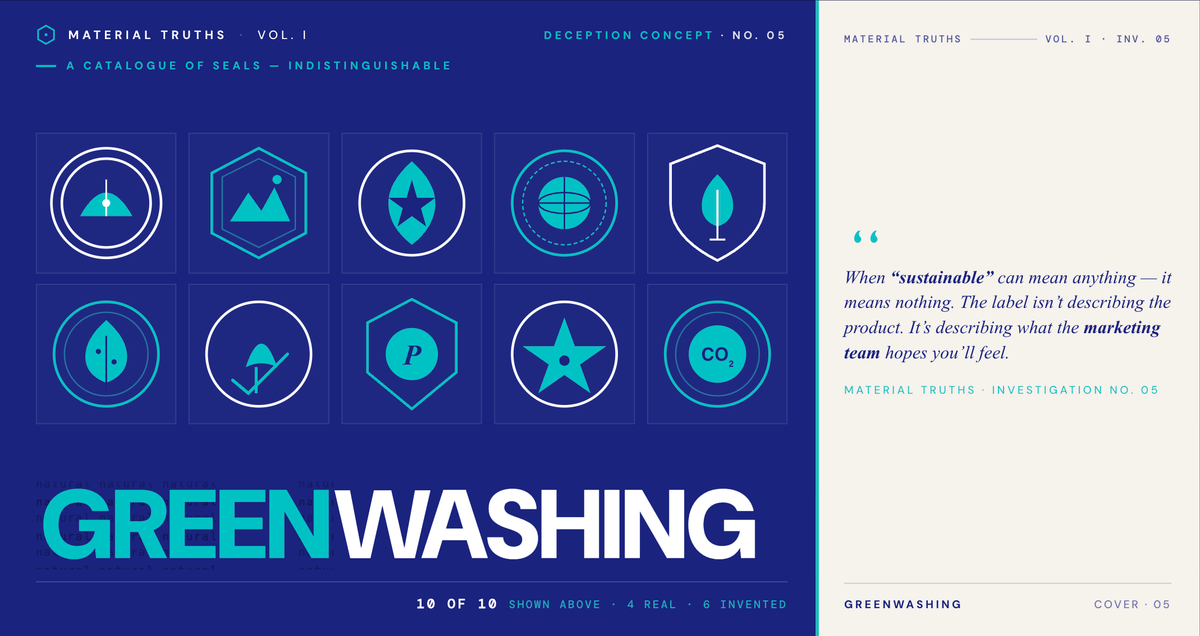
- Fabricated or meaningless certifications. Self-created seals designed to look like third-party certifications. Industry-created programs that certify virtually all applicants.
- Imagery implying natural origins. Green color schemes, leaf imagery, nature photography, and pastoral branding used for products made from synthetic materials.
- Carbon offset claims. Carbon-neutral certifications based on offset purchases of questionable quality, with no disclosure of how offsets were verified.
- False comparatives. "Made with 50% less plastic" — compared to what? Without a baseline, the claim is meaningless.
What are the FTC Green Guides?
The Federal Trade Commission's Guides for the Use of Environmental Marketing Claims, located at 16 CFR Part 260, are the primary U.S. regulatory framework for environmental advertising claims. The Green Guides are interpretive guidance, not direct regulations — the FTC prosecutes violations under Section 5 of the FTC Act as unfair or deceptive practices, using the Green Guides as the standard for what constitutes deception.
Key principles of the Green Guides:
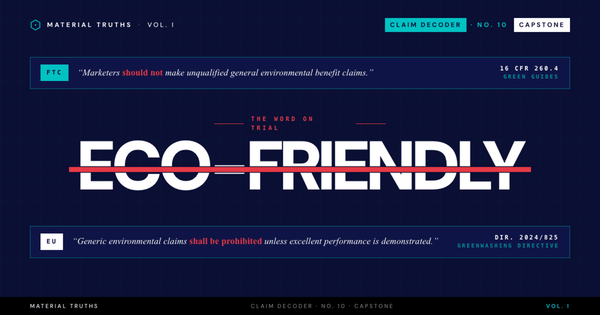
1. General environmental benefit claims. Unqualified general claims ("eco-friendly," "green") are cautioned against because they imply broad benefits few products can substantiate. General claims should be qualified with specific information about what environmental benefit the product provides.
2. Carbon offsets. Brands claiming carbon-neutral status through offsets must identify the offsets used, ensure they meet standards for additionality and permanence, and disclose the offset methodology.
3. Biodegradable. A product can only be labeled biodegradable without qualification if it will completely break down and return to nature within a reasonably short period under customary disposal conditions — typically within one year in a landfill.
4. Recyclable. Products can be labeled recyclable only if the recycling facilities for that material are available to a substantial majority of consumers where the product is sold. Local availability matters.
5. Compostable. The product must break down into usable compost in a safe, timely manner in customary home or municipal composting facilities.
6. Free of / non-toxic. Claims that a product is free of a substance are misleading if the substance has never been associated with that product category (e.g., "gluten-free water").
7. Certifications and seals. Third-party certifications must be from genuinely independent organizations. Brands cannot create their own seals that imply third-party certification.
The FTC announced in 2022 that it was initiating a review of the Green Guides, the first major revision since 2012. As of early 2026, the revised Green Guides have not yet been finalized.
What are the most common greenwashing tactics?
A practical taxonomy of greenwashing patterns observed across consumer products:
| Tactic | Example | Why it misleads |
|---|---|---|
| Vague modifiers | "Eco-friendly packaging" | No baseline, no specific benefit claimed |
| Relevant-sounding terminology | "Plant-based materials" | Fabrics like rayon and viscose are plant-derived but chemically processed |
| Irrelevant attributes | "CFC-free aerosol" (CFCs banned decades ago) | True but meaningless |
| Self-created seals | "Certified Eco-Responsible™" | Trademarked names, no independent body |
| Offset-based claims | "Carbon neutral" via unverified offsets | Offsets often do not represent actual emissions reductions |
| Aspirational goals | "Net zero by 2030" | Commitment without current accountability |
| Green branding without substance | Leaf imagery, recycled-looking paper, earth-tone colors on ordinary products | Implies environmental identity without substantiating claims |
How can consumers spot greenwashing?
- Demand specificity. "20% recycled content" is verifiable. "Eco-friendly" is not. Default skepticism to any general environmental claim without specific qualification.
- Verify certifications at the source. Every legitimate environmental certification has a public registry. USDA Organic at usda.gov; Forest Stewardship Council at fsc.org; EPA Safer Choice at epa.gov/saferchoice; ENERGY STAR at energystar.gov; Fair Trade at fairtradecertified.org. If a seal appears on a product, search the certifying body's database for the product or brand.
- Be cautious of self-created seals. If a seal says "Certified [Brand] Eco-Responsible" or uses the brand's own graphic design style, it is likely a self-created marketing device.
- Consider the full product lifecycle. A single green attribute doesn't offset an unsustainable overall product. Fast fashion made from recycled polyester is still fast fashion.
- Check whether comparisons are specified. "Made with less plastic" is meaningless without specifying "less than what."
- Look for published life cycle assessments. Brands with genuine environmental commitments often publish third-party life cycle assessments quantifying impact across production, distribution, use, and disposal.
- Search for past enforcement. A brand cited previously for environmental claims issues is more likely to repeat the pattern.
Recent enforcement actions on greenwashing
Greenwashing enforcement has accelerated significantly through 2024-2026, driven by both regulatory action and class action litigation:
- Class actions. Multiple U.S. class actions have been filed against consumer brands over unsubstantiated carbon-neutral claims, recyclability representations, and "plant-based" product claims. Courts have generally held that state consumer protection laws apply to environmental marketing claims even where the claim does not meet the technical Section 5 deception standard.
- EU Greenwashing Directive. The European Union's Empowering Consumers for the Green Transition Directive must be implemented by EU member states by March 27, 2026, with rules applying from September 27, 2026. It prohibits carbon-neutral claims based on offsetting, requires substantiation for future environmental claims through monitored implementation plans, and restricts self-created certification labels. Products sold in the EU must comply regardless of where brands are based.
- State AG actions. California's Attorney General and the New York Attorney General have both pursued investigations of consumer brands over environmental marketing claims, often resulting in settlements requiring brands to revise labeling.
This section is updated as new enforcement actions are documented.
What's the difference between greenwashing and sciencewashing?
See the comparison table on our sciencewashing reference page. Briefly: sciencewashing covers misleading technology and efficacy claims; greenwashing covers misleading environmental claims. The two practices frequently coexist on the same product — for example, a bedding product that claims both "patented cooling technology" and "eco-friendly sustainable materials" without substantiating either.
Frequently asked questions
What is greenwashing? Making misleading or unsubstantiated claims about the environmental benefits of a product, service, or practice.
Is greenwashing illegal? When claims are false or unsubstantiated, yes — under Section 5 of the FTC Act, state consumer protection laws, and the EU Greenwashing Directive for products sold in Europe.
What are the FTC Green Guides? FTC's Guides for the Use of Environmental Marketing Claims at 16 CFR Part 260, providing standards for environmental advertising.
What does "eco-friendly" actually mean legally? The FTC cautions against unqualified general claims like "eco-friendly" because they imply broad benefits few products can substantiate.
What is "carbon neutral" misuse? Carbon-neutral claims based on low-quality offsets, or without disclosure of offset methodology, are a primary greenwashing concern.
How can I verify a brand's sustainability claims? Verify certifications at the certifying body's website, demand specific quantified claims rather than vague terms, and look for published life cycle assessments.
Further reading
- Sciencewashing: The adjacent practice involving technology and efficacy claims
- Made in USA: Country-of-origin claims often intersect with greenwashing
- Claims decoder: "Eco-Friendly": Specific decoder page
- Claims decoder: "Non-Toxic": Related claim
Sources
- FTC. "Guides for the Use of Environmental Marketing Claims." 16 CFR Part 260. ftc.gov/legal-library/browse/rules/green-guides
- European Commission. "Empowering Consumers for the Green Transition Directive" (Directive 2024/825). Implementation by March 27, 2026.
- FTC. "Environmentally Friendly Products: FTC's Green Guides." Consumer information resource. ftc.gov
- USDA, EPA, FSC, ENERGY STAR, and other certification body websites listed above.
Get notified when we add new enforcement examples to this page.