"Patented" Claims: How to Verify in 60 Seconds Using Free USPTO Tools

Last updated: May 11, 2026
Every legitimate patent has a unique number, is publicly searchable in free government databases, and has a specific expiration date. A product marketed as "patented" should be verifiable in under 60 seconds using Google Patents or the USPTO database. Claims that cannot be verified — either because no patent exists, the patent is held by a third party without licensing disclosure, or the patent has expired — violate 35 U.S.C. §292 (the federal false marking statute) and create exposure under FTC Act Section 5 and state consumer protection laws. This decoder walks through the verification workflow, the red flags of fake patent claims, and how to distinguish real patented technology from marketing fiction.
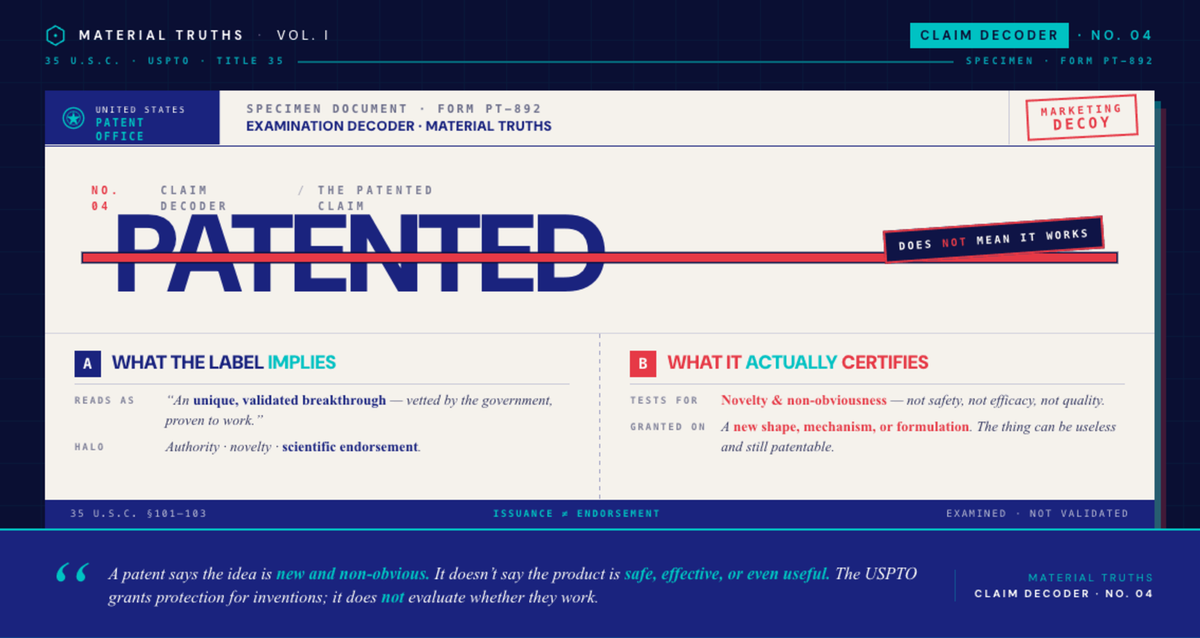
What does "patented" mean on a product?
A "patented" claim should mean the product or its specific technology is protected by an issued patent from the United States Patent and Trademark Office (USPTO) or another national patent office. A patent is a time-limited monopoly granted by the government in exchange for public disclosure of an invention.
Every issued U.S. patent has:
- A unique number (utility patents are currently in the 11-12 million range)
- A publicly available specification describing the invention
- A set of claims defining what is legally protected
- An assigned owner (the entity that filed the application)
- A filing date and an issue date
- A calculable expiration date
- Ongoing maintenance fee requirements to stay active
Because all of this information is public, verifying a patent claim is fast and free. If a brand says its product is patented and the patent cannot be found, the claim is false, refers to a patent the brand does not own, or refers to a pending application that has not yet been granted.
The 60-second verification workflow
Step 1: Google Patents. Go to patents.google.com. Search by the brand name as assignee (the filter at the top of results lets you specify "Assignee"). Also search by the specific technology term the brand uses — for example, if the brand claims "patented ThermaCool technology," search for "ThermaCool" with the brand name as assignee.
Step 2: Read the results. If matching patents appear, check:
- Does the patent currently list the brand as assignee? (Ownership can change.)
- Is the patent active? Expired patents no longer grant exclusive rights.
- Does the patent's claims section actually cover what the brand is marketing?
Step 3: USPTO Patent Full-Text Database. Located at ppubs.uspto.gov (and the newer patents.uspto.gov interface). This is the authoritative source. Use it to verify anything found on Google Patents and as a backup if Google Patents shows no results.
Step 4: USPTO Assignment Database. Located at assignment.uspto.gov. If the patent exists but the brand isn't the current assignee, search here to see if the brand licenses the patent or if there's a documented relationship. Assignment records show all ownership changes and many licensing agreements.
If none of these sources produce a patent matching the brand's claim, the claim is not substantiated. The brand may be:
- Falsely claiming patent protection it does not have
- Referring to a "patent pending" application as a granted patent
- Referring to someone else's patent without proper licensing
- Using "patented" as marketing language with no underlying patent at all
What "patent pending" actually means
"Patent pending" means a patent application has been filed with the USPTO. It does not mean:
- That a patent will ever issue
- That any legal protection currently exists
- That the invention is novel or substantively different from existing products
- That USPTO has examined the application
The average U.S. patent application takes 18 to 36 months to process, with many extending longer through continuation practice and appeals. Approximately 90 percent of applications are eventually issued, but the path includes many that are abandoned, amended substantially, or rejected.
Products can be marked "patent pending" indefinitely as long as there's an actual pending application. When the application is abandoned or the patent issues, the marking must change. A product marked "patent pending" for years without any patent eventually issuing may still be truthful marking (if the application remained pending during that time), but becomes false marking once the application is abandoned.
"Patent pending" is legally weaker than a granted patent but still has strategic value — it signals to competitors that a patent may issue and grant enforceable rights.
What's the difference between owning and licensing a patent?
Both are legitimate, but the distinction matters for consumer-facing marketing.
Owning a patent. The USPTO issued the patent directly to the company. The company is listed as the assignee of record. It can use the technology exclusively and license it to others. This is the strongest form of patent claim.
Licensing a patent. The company pays another patent holder for the right to use the technology. The underlying patent is owned by someone else. Licensed technology can still legitimately be called "patented" because the patent exists, but proper marketing should disclose the licensing relationship.
The deceptive pattern: A brand markets a product as "our patented technology" when the patent is actually owned by a supplier or licensor. The brand is using licensed technology but implying ownership. This is a specific sciencewashing pattern documented in Material Truths investigations across bedding, skincare, and consumer electronics categories.
How to verify: USPTO assignment records at assignment.uspto.gov show the current assignee. If the brand is the assignee, it owns the patent. If someone else is the assignee, the brand at best has a license — and the specific licensing relationship should be disclosed in the brand's marketing.
How long do patents last?
Different patent types have different durations:
| Patent type | Duration | Start date |
|---|---|---|
| Utility | 20 years | From earliest filing date |
| Design | 15 years | From grant date (for applications filed on or after May 13, 2015) |
| Plant | 20 years | From filing date |
All patents require periodic maintenance fees. Unpaid maintenance fees cause a patent to lapse before its full term.
Why expiration matters for consumers: When a patent expires, the technology enters the public domain. Any company can use it freely. Brands that continue marketing products as "patented" after expiration are making a technically false claim. This pattern is particularly common with older technologies where the brand's premium pricing was built around patent exclusivity that no longer exists.
How to check expiration: USPTO patent records show filing and issue dates. Utility patents expire 20 years from the filing date; apply that math. Google Patents often displays estimated expiration dates directly.
Is claiming a false patent illegal?
Yes. Multiple legal frameworks apply:
1. Federal false marking — 35 U.S.C. §292. Marking a product as patented when it is not, or marking it as patent pending when no application has been filed, is a federal offense. Fines of up to $500 per offense, with courts interpreting "offense" to include each individual falsely marked article in certain cases. This statute was historically underenforced but has been used in class actions and qui tam (whistleblower) actions.
2. FTC Act Section 5. False patent claims can be pursued as deceptive advertising. The FTC has brought cases specifically challenging unsubstantiated patent claims as deceptive.
3. State consumer protection laws. California's Consumers Legal Remedies Act, New York General Business Law §§ 349 and 350, and similar state statutes have produced successful class actions for false patent marketing. These typically result in injunctive relief and consumer restitution.
4. Lanham Act — 15 U.S.C. § 1125(a). Competitors can sue for false patent claims that affect market competition. Lanham Act claims often produce faster resolutions than agency enforcement.
Enforcement of false marking is inconsistent because the statute historically required proving intent to deceive. Courts have tightened this requirement over time, making some cases harder to prosecute. But the cumulative exposure from multiple legal frameworks means brands making false patent claims face real risk, even when any single framework's enforcement is uneven.
Common fake "patented" claims
Patterns documented in Material Truths investigations and FTC enforcement:
- "Patented formula" with no identifiable patent number. A formula can be patented, but only if it meets USPTO patentability requirements. Most "patented formulas" are trademarked names for commodity formulations.
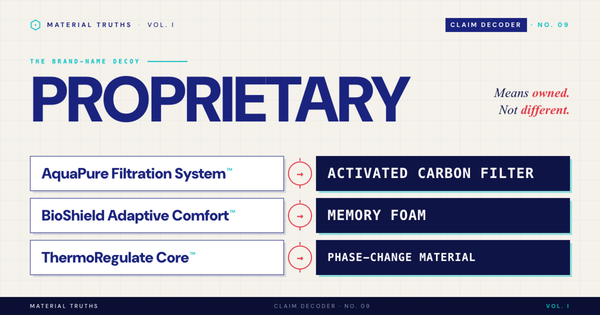
- "Patented technology" citing trademark registration. The ™ or ® symbol protects a name, not technology. See our page on patent vs. trademark for the distinction.
- "Patent pending" indefinitely. Applications that have been abandoned or never actually filed.
- "Internationally patented." Patents are national. A patent granted in Japan has no legal effect in the U.S. without separate U.S. patent protection. "Internationally patented" often obscures that no U.S. patent exists.
- "Patented by [scientific institution]." Academic institutions rarely endorse consumer products. A licensed patent from a university should be clearly disclosed as licensed, not implied as endorsed.
- "Our patented process." Applied to processes that are not novel and would not meet patentability requirements. Sometimes refers to a trade secret, which is protected differently than a patent.
Frequently asked questions
What does "patented" mean on a product? The product or technology is protected by an issued patent, identifiable by a unique number in USPTO databases.
How do I verify a "patented" claim in 60 seconds? Google Patents (patents.google.com), search by brand as assignee or technology term. If no results, USPTO Patent Full-Text Database (ppubs.uspto.gov). If the patent isn't there, the claim is not substantiated.
What does "patent pending" mean? An application has been filed, not yet examined or granted. No legal protection yet exists.
Is claiming a false patent illegal? Yes, under 35 U.S.C. §292, FTC Act Section 5, state consumer protection laws, and Lanham Act.
How long do patents last? Utility: 20 years from filing. Design: 15 years from grant. Plant: 20 years from filing.
Owning vs. licensing a patent? Owned patents are assigned to the brand directly; licensed patents are owned by third parties and used under agreement. Both are legitimate but should be disclosed accurately.
Further reading
- Patent vs. Trademark: The foundational distinction
- Sciencewashing: Pattern false patent claims fit into
- Proprietary Blend: Adjacent "proprietary" pattern
- Claim decoder: "Proprietary": The adjacent marketing term
Sources
- USPTO. "General Information Concerning Patents." uspto.gov/patents/basics
- USPTO Patent Full-Text Database. ppubs.uspto.gov
- Google Patents. patents.google.com
- USPTO Assignment Database. assignment.uspto.gov
- 35 U.S.C. §292 — False marking statute.
- 35 U.S.C. §154 — Contents and term of patent.
- FTC Act Section 5, 15 U.S.C. § 45.
- Lanham Act, 15 U.S.C. § 1125(a).