Anchor Pricing: How "Fake Original Prices" Inflate Perceived Discounts

Last updated: May 4, 2026
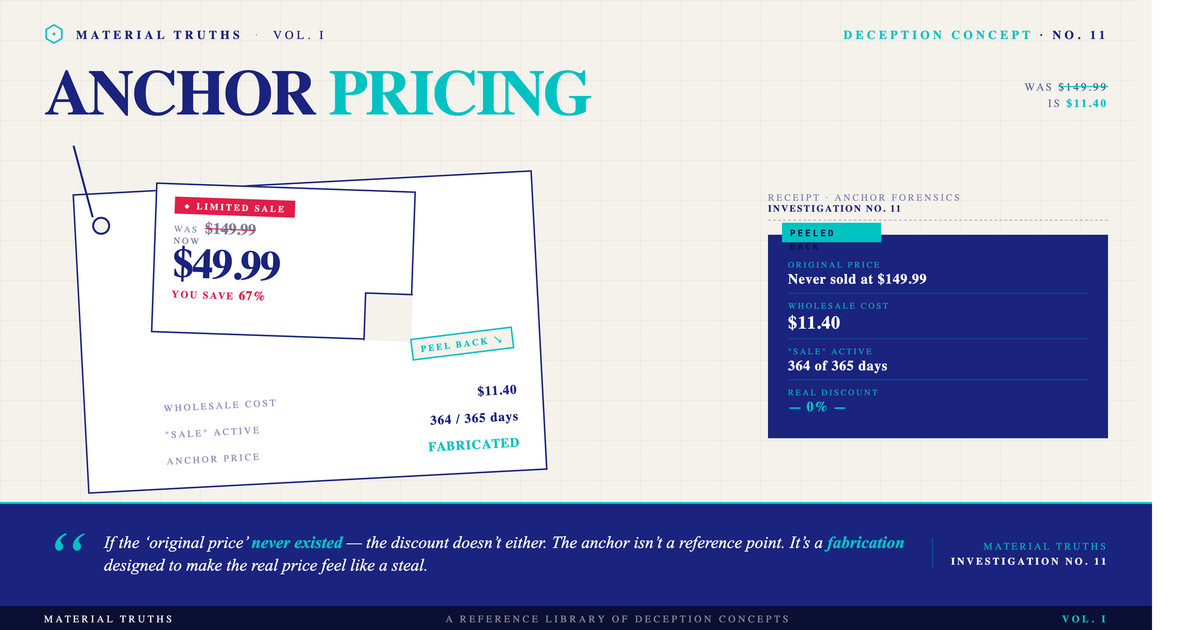
Anchor pricing displays a fabricated or inflated "original" or "retail" price next to a lower current price to create the impression of a significant discount. When the anchor price is fabricated — the product has never actually sold at that price — the practice is deceptive under Section 5 of the FTC Act, the FTC's Guides Against Deceptive Pricing (16 CFR Part 233), and state consumer protection laws. Anchor pricing is particularly pervasive on TikTok Shop, outlet retailers, and DTC brands that use perpetual "sale" pricing as their actual baseline.
What is anchor pricing?
Anchor pricing exploits a well-documented cognitive bias: when people evaluate a price, they compare it to a reference point. If a shirt is $40, consumers may have no strong view on whether $40 is a fair price. But if the same shirt is displayed as "$40, originally $120, 67% off," the $120 anchor makes the $40 feel like a bargain. The anchor reframes evaluation.
The psychology is real. The deception occurs when the anchor is fabricated.
Legitimate reference pricing exists. A product genuinely sold at $120 for months and reduced to $40 during a sale can honestly advertise the 67% discount. What brands increasingly do instead is:
- List a "suggested retail price" or "MSRP" that has never been charged anywhere
- Run perpetual "60% off" sales where the sale price is the actual price
- Use "compare at" or "was $X" language referring to prices never actually in effect
- Set brand website prices different from Amazon or retailer prices to obscure actual market pricing
When the reference price is fabricated or the product has never been offered at that price in good faith for a substantial period, the pricing crosses from persuasion into deception.
Is fake retail pricing legal?
Fabricated retail or list prices that create false impressions of discount are prohibited under multiple legal frameworks.
Federal: Section 5 of the FTC Act. The FTC's Guides Against Deceptive Pricing, located at 16 CFR Part 233, specifically address pricing comparisons. The guides state that advertising a former price requires:
- The product was actually offered at the former price
- The offering was in good faith, not merely to establish a fictional higher price
- The offering was for a substantial period of time, not a nominal interval
Reference to a manufacturer's suggested retail price (MSRP) or "list price" is permissible only when the MSRP represents a price at which the product is generally sold in the relevant market, not a price invented to support a discount claim.
California: Business and Professions Code Section 17501. California's state law is notably stricter than federal rules. It prohibits comparison to a former price unless the former price was the prevailing market price within three months prior to the advertisement. Violations can trigger private class actions under the Consumers Legal Remedies Act.
New York: General Business Law §349. General prohibition on deceptive trade practices, regularly applied to deceptive pricing in class actions.
Other states. Most states have consumer protection statutes that reach deceptive pricing. Massachusetts, Washington, Florida, Texas, and Illinois have all produced notable class actions.
The cumulative effect: brands that use fabricated anchor pricing face federal FTC exposure, state regulatory exposure, and private class action exposure simultaneously.
How do brands manipulate perceived discounts?
Six common tactics:
1. Fabricated MSRP. Listing a "manufacturer's suggested retail price" that no retailer has ever charged. Particularly common on drop-shipped products where the "MSRP" is invented to support the discount narrative.
2. Perpetual sales. Running "60% off" promotions continuously, such that the sale price is the actual price and the "original" price exists only to anchor perception. Common at outlet retailers and DTC brands.
3. "Compare at" pricing. Using "Compare at $120" language that references what similar products cost elsewhere, without the compared product being genuinely equivalent. Outlet stores use this pattern extensively.
4. Fabricated countdown urgency. Pairing anchor pricing with "sale ends in 4 hours" countdowns that reset indefinitely. Creates false urgency around false discounts.
5. Cross-platform price variation. Setting prices on brand websites higher than on Amazon, then advertising the Amazon price as "discounted" from the website price. The website price functions as an anchor that serves marketing rather than retail.
6. Bundled anchor pricing. Presenting a bundle as discounted against the sum of fabricated individual prices. "A $200 value for $79" when the individual items have never been priced at values summing to $200.
How can consumers detect anchor pricing?
Several practical approaches:
1. Check price history. For Amazon products, CamelCamelCamel (camelcamelcamel.com) and Keepa (keepa.com) track price history over time. If the "original $120" price has never appeared in history and the product has always sold at $49, the $120 is an anchor fabrication.
2. Cross-platform comparison. Compare the brand's own website, Amazon, Walmart, Target, and third-party retailers. If the brand website lists $120 and every other platform shows $49, the $120 is an anchor.
3. Wholesale source check. For drop-shipped products, search AliExpress, Alibaba, or DHgate for the same product. If the wholesale cost is $4 and the "MSRP" is $120, the MSRP is almost certainly fabricated.
4. Brand website archive check. The Internet Archive's Wayback Machine (web.archive.org) preserves historical snapshots of brand websites. Checking the product page from months or years ago often reveals whether the "original" price ever existed.
5. Ignore the anchor; evaluate the price. The most reliable defense: decide what the product is actually worth to you, independent of any comparison price. If the current price is reasonable for what you're getting, that's what matters. If it isn't, the "discount" is irrelevant.
6. Search the brand + "deceptive pricing" or "class action." Brands with prior deceptive pricing challenges often continue the pattern. Prior litigation is public record.
Recent enforcement actions on anchor pricing
Significant actions in this space:
FTC actions. The FTC has pursued deceptive pricing cases against outlet retailers and DTC brands, typically resulting in consent orders prohibiting fabricated reference pricing. The 2015 J.C. Penney settlement is a canonical case, producing substantial consumer redress and ongoing compliance requirements.
Class actions. Major consumer class actions under California's Section 17501, New York's §349, and similar state laws have targeted:
- Major department stores (Macy's, Kohl's, J.C. Penney) for fabricated "original" prices on perpetually discounted items
- Outlet retailers (Michael Kors, Nike, and others) for "compare at" prices that did not reference genuine prevailing market prices
- DTC brands for "retail $X" pricing that was invented to support discount marketing
Settlement amounts in these cases have ranged from millions to tens of millions of dollars, with injunctive relief requiring brands to discontinue the challenged pricing practices.
State AG actions. The California Attorney General, New York Attorney General, and Massachusetts Attorney General have all brought deceptive pricing cases, often in coordination with class actions.
TikTok Shop pattern. As TikTok Shop has grown, FTC attention to fabricated pricing on the platform has increased. Watch for dedicated enforcement actions focused on the TikTok Shop anchor pricing pattern, which combines the fabricated MSRP with urgency countdowns and drop-ship fulfillment.
This section is updated as new enforcement actions are documented.
Frequently asked questions
What is anchor pricing? Displaying a fabricated or inflated reference price to make a current price appear discounted. Deceptive when the reference price is invented.
Is fake retail pricing legal? No. Prohibited under FTC Act Section 5, FTC Guides Against Deceptive Pricing (16 CFR Part 233), and state laws including California Business and Professions Code Section 17501.
How do brands manipulate perceived discounts? Fabricated MSRPs, perpetual sales, "compare at" pricing, countdown urgency, cross-platform price variation, bundled anchors.
How can consumers detect anchor pricing? Check CamelCamelCamel or Keepa for Amazon price history, compare across platforms, check wholesale sources, use the Wayback Machine, search for prior litigation against the brand.
Recent enforcement actions? FTC's J.C. Penney settlement (2015), major class actions against Macy's, Kohl's, Michael Kors, and others under state pricing laws.
Does the FTC regulate "always on sale" pricing? Yes. Perpetual sales where the product never sold at the stated "regular" price violate the Guides Against Deceptive Pricing.
Further reading
- Drop Shipping Scam: Anchor pricing commonly accompanies drop shipping
- Sciencewashing: Often paired with inflated pricing to justify premium positioning
- Made in USA: Fabricated origin claims often support premium anchor pricing
Sources
- FTC. "Guides Against Deceptive Pricing." 16 CFR Part 233. ftc.gov/legal-library/browse/rules
- California Business and Professions Code Section 17501. codes.findlaw.com
- FTC Act Section 5, 15 U.S.C. § 45.
- CamelCamelCamel. camelcamelcamel.com
- Keepa. keepa.com
- Internet Archive Wayback Machine. web.archive.org