Made in USA: What the FTC Rule Requires, Real Enforcement Cases, and How to Verify

Last updated: April 28, 2026
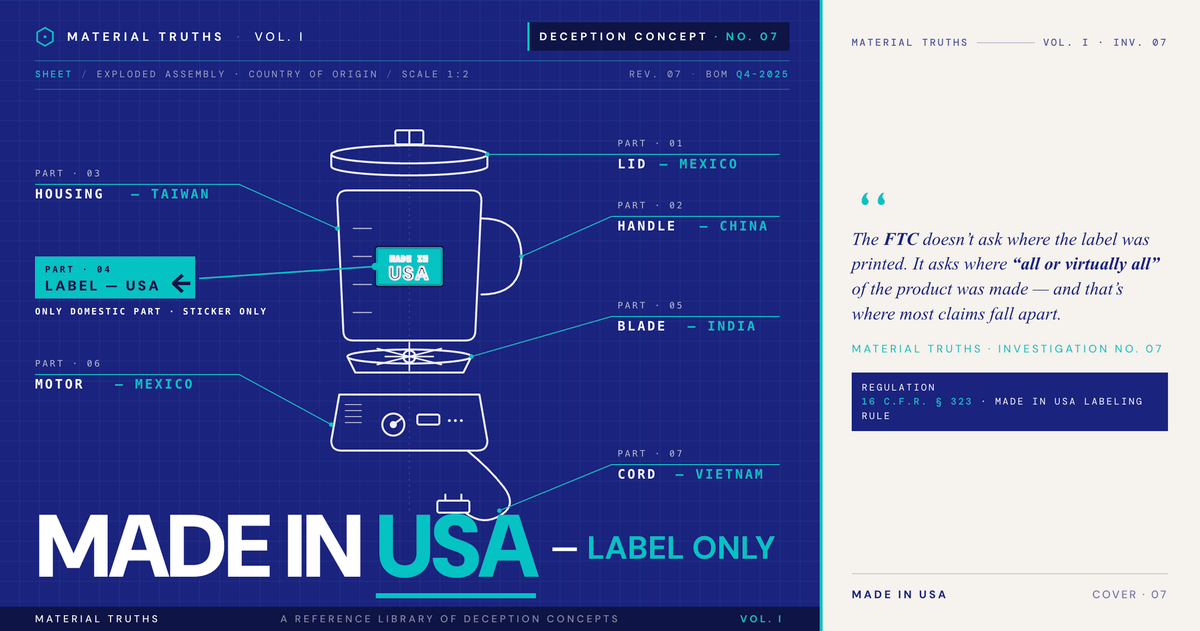
An unqualified "Made in USA" claim requires, under the FTC's Made in USA Labeling Rule, that the product's final assembly occurs in the United States, all significant processing occurs in the United States, and all or virtually all ingredients or components are U.S.-sourced. The "all or virtually all" standard is the most important and most frequently violated requirement. Recent enforcement has included Williams-Sonoma's $3.175 million penalty in 2024, a $2.36 million class action verdict against R.C. Bigelow, and the FTC's April 2026 enforcement sweep targeting multiple brands.
What does "Made in USA" legally mean?
The FTC's Made in USA Labeling Rule, codified at 16 CFR Part 323 and effective since August 2021, formalizes decades of FTC enforcement policy. An unqualified "Made in USA" claim — a claim without any qualifying language like "Assembled in USA from global components" — requires three conditions to be true:
- Final assembly or processing occurs in the United States. The final step that transforms the product into its finished form must take place on U.S. soil.
- All significant processing occurs in the United States. Not just the final step, but all substantial manufacturing steps must be U.S.-based.
- All or virtually all ingredients or components are made and sourced in the United States. Raw materials, components, and subassemblies must originate in the U.S., with only negligible foreign content permitted.
The rule applies to any unqualified claim — whether the literal phrase "Made in USA" appears, or whether the claim is implied through American flags, U.S. imagery, "American-made" phrasing, or similar representations. The FTC evaluates the overall net impression, meaning imagery and context matter as much as literal text.
The rule does not require any product to be made in the U.S. It only governs claims about whether products are made in the U.S. A brand can sell foreign-manufactured products freely; it simply cannot claim they are Made in USA without qualification.
The "all or virtually all" standard
"All or virtually all" is the linchpin phrase. The FTC has deliberately not set a precise numerical threshold because the standard is qualitative rather than quantitative.
What "virtually all" requires:
- Negligible foreign content. The total foreign content must be small enough that a reasonable consumer would not consider the product to contain meaningful non-U.S. components.
- Non-essential foreign components. Even small foreign content can undermine the claim if the foreign part is essential to the product's function. A tiny imported screw is different from a tiny imported core component.
- U.S.-sourced raw materials where possible. When raw materials of a certain type are available domestically, using foreign raw materials counts against the claim.
- Final assembly and significant processing in the U.S. Even if all components are U.S.-sourced, final assembly abroad disqualifies the claim.
California's state Made in USA rule, under Business and Professions Code Section 17533.7, provides a more specific numerical standard: 5 percent foreign content (10 percent if the foreign materials are not available domestically). Products sold in California must satisfy both the federal and California standards. Other states have varying or no specific rules.
"Assembled in USA" vs. "Made in USA" - the critical distinction
The difference between these two claims is legally important and consumer-invisible.
| Claim | What's required | What's permitted |
|---|---|---|
| Made in USA (unqualified) | All or virtually all U.S. content | Negligible foreign content |
| Assembled in USA (qualified) | Substantial transformation in U.S. | Foreign components permitted |
| Made in USA from global components | Final assembly in U.S. | Foreign sourcing acknowledged |
| Designed in USA | Design work in U.S. | Manufacturing anywhere |
| American Made / Made in America | Same as "Made in USA" under FTC | Same requirements |
A product with substantial foreign components can truthfully claim "Assembled in USA" if it underwent substantial transformation on U.S. soil. It cannot truthfully claim unqualified "Made in USA."
The legal risk for brands: "Made in USA" costs the same to print as "Assembled in USA from global components," but the liability exposure is very different.
Recent major enforcement actions
The FTC has significantly intensified Made in USA enforcement through 2024-2026:
Williams-Sonoma — $3.175 million penalty (April 2024). The kitchen retailer paid the largest civil penalty in Made in USA Labeling Rule history for violating a prior 2020 FTC order related to deceptive U.S.-origin claims. The case established that repeat offenders face elevated penalties.
Kubota — $2 million penalty (January 2024). The tractor manufacturer paid the first major penalty under the Made in USA Labeling Rule for false claims on certain product labels for replacement parts. The case was significant for establishing that even replacement parts fall under the rule.
R.C. Bigelow class action — $2.36 million verdict (April 2025). A California jury found the tea manufacturer liable in a class action for labeling tea products as "Manufactured in the USA 100%" while the tea leaves were imported. The verdict demonstrated that class actions can succeed even without FTC involvement.
July 2025 FTC warning letters. Following a March 2025 Executive Order "Ensuring Truthful Advertising of Products Claiming to be Made in America," the FTC issued warning letters to multiple companies in July 2025 and declared July 2025 "Made in the USA Month."
April 2026 FTC enforcement sweep. The FTC announced three law enforcement actions simultaneously on April 14, 2026:
- TouchTunes Music Company: Settled with $625,000 in consumer redress under Section 19 of the FTC Act — the largest redress amount for a Made in USA Labeling Rule case to date.
- Americana Liberty LLC / Three Nations LLC: Named individual principals alongside corporate entities for false "Made in the USA" claims on flag display and related products.
- Oak Street Manufacturing Company (Oak Street Bootmakers): Settled over claims that footwear products were "handcrafted 100%" in the United States "from heel-to-toe, using no pre-assembled components from overseas," when imported components were used and some assembly occurred outside the U.S.
Class action surge. As of December 1, 2025, at least 20 Made in USA consumer class actions had been filed during 2025 — nearly triple the seven filed in all of 2024. Legal analysis publications have documented the pattern as a material increase in enforcement exposure.
How can consumers verify origin claims?
Practical verification steps:
1. Check country-of-origin labels. Federal customs law requires country-of-origin marking on most imported goods — textiles, apparel, food, and many consumer products. An unmarked product sold as Made in USA should be verifiable by looking for the required marking (or its absence).
2. Search import records. Platforms like ImportYeti, Panjiva, and Datamyne aggregate U.S. customs import data from bills of lading. Searching a brand's name often reveals actual foreign supplier relationships even when the brand markets exclusively domestic origins.
3. Examine product specifications. Product listings on Amazon, brand websites, and retailer sites often include "Country of Origin" fields in the specifications. This information, while self-reported, is typically more accurate than marketing copy because it's generated for customs and logistics purposes.
4. File FTC complaints. Consumer complaints submitted at reportfraud.ftc.gov feed into FTC enforcement priority setting. Multiple complaints about the same brand elevate FTC attention.
5. Direct inquiry. Brands with legitimate U.S. manufacturing typically respond promptly with specifics about their facilities. Brands with ambiguous claims often deflect or provide vague responses.
6. Check for recent enforcement. Brands previously cited for Made in USA issues are more likely to continue the pattern. FTC enforcement records are publicly searchable.
What penalties exist for false origin claims?
The penalty structure:
- FTC civil penalties. Up to $53,088 per violation as of 2025, with each product or label potentially counted separately. The Williams-Sonoma $3.175 million settlement and TouchTunes $625,000 redress demonstrate the scale possible.
- Individual executive liability. Recent FTC enforcement has named individual owners and executives alongside corporate entities (Lions Not Sheep, Lithionics Battery, and Americana Liberty matters).
- State consumer protection penalties. California's rule and similar state statutes enable state-level enforcement and class action litigation.
- Federal False Claims Act exposure. For products sold through federal government contracts, falsely claiming U.S. origin can trigger False Claims Act liability, with treble damages.
- Class action damages. As the R.C. Bigelow $2.36 million verdict demonstrates, class actions can result in substantial private enforcement even without government action.
Frequently asked questions
What does "Made in USA" legally mean? Final assembly in U.S., all significant processing in U.S., all or virtually all content U.S.-sourced. Governed by 16 CFR Part 323.
What is the "all or virtually all" standard? Qualitative — negligible foreign content, non-essential foreign components, no precise numerical threshold federally though California uses 5-10%.
What's the difference between "Assembled in USA" and "Made in USA"? Assembled in USA allows foreign components if substantial transformation occurs in the U.S.; Made in USA requires virtually all U.S. content.
Recent major enforcement actions? Williams-Sonoma $3.175M (2024), Kubota $2M (2024), R.C. Bigelow $2.36M class action (2025), FTC April 2026 sweep with TouchTunes, Americana Liberty, Oak Street.
How can consumers verify origin claims? Country-of-origin labels, import records via ImportYeti, product specifications, FTC complaints, direct inquiry.
What penalties exist? Up to $53,088 per FTC violation, individual executive liability, state actions, class actions, potential False Claims Act exposure.
Further reading
- Made in USA: Full reference page on FTC enforcement and verification
- Greenwashing: Often intersects with Made in USA claims
- FTC Consent Order: What happens when brands settle
Sources
- FTC. "Made in USA Labeling Rule." 16 CFR Part 323. ftc.gov/legal-library/browse/rules/made-usa-labeling-rule
- FTC. Press releases: Williams-Sonoma (April 2024), Kubota (January 2024), April 2026 enforcement sweep (Americana Liberty, TouchTunes, Oak Street). ftc.gov/news-events
- Executive Order, "Ensuring Truthful Advertising of Products Claiming to be Made in America," March 13, 2025.
- California Business and Professions Code Section 17533.7.
Get notified when we add new enforcement examples to this page.