The Consumer Deception Playbook: 12 Marketing Patterns That Mislead Shoppers (And How to Spot Each One)

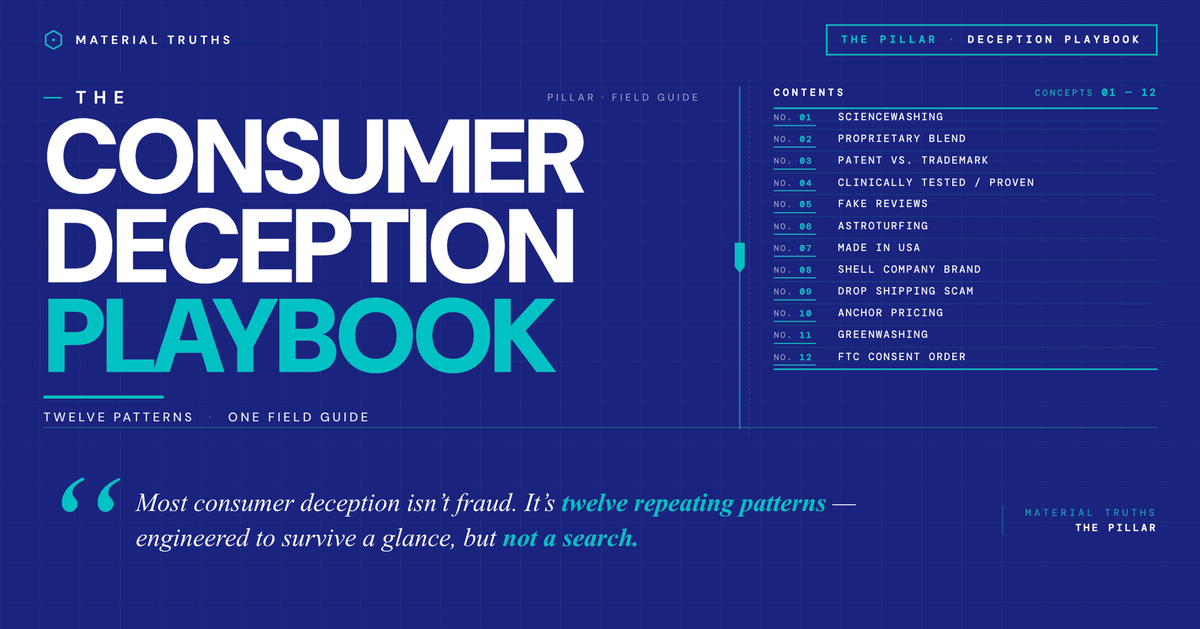
Most consumer deception isn't outright fraud. It's pattern recognition gone wrong - twelve repeating marketing tactics, refined across decades of consumer goods advertising, now compressed into the seconds it takes to scroll past a TikTok Shop listing or click "Add to Cart" on a DTC site. None of them require a brand to lie outright. All of them are designed to bypass the kind of scrutiny that would unwind a purchase.
This is the Material Truths Consumer Deception Playbook: a complete reference to the twelve patterns we document across our investigations, with the legal context, the red flags, and the verification steps for each. If you have sixty seconds before buying, this is what to check.
Quick reference: the 12 patterns
| # | Pattern | Where you see it most | The one question that breaks it |
|---|---|---|---|
| 1 | Sciencewashing | Supplements, skincare, bedding | "What is the patent number?" |
| 2 | Proprietary Blend | Supplements, nootropics | "What is the dose of each ingredient?" |
| 3 | Patent vs. Trademark | Anything with a ™ or ® near a tech-sounding name | "Is this an invention or a name?" |
| 4 | Clinically Tested vs. Clinically Proven | Personal care, supplements | "Can I see the published study?" |
| 5 | Fake Reviews | Amazon, TikTok Shop, DTC | "What does Reddit say?" |
| 6 | Astroturfing | Social media, "viral" launches | "Is this account real?" |
| 7 | Made in USA | Home goods, apparel, supplements | "Where is it assembled vs. made?" |
| 8 | Shell Company Consumer Brand | TikTok Shop, Amazon storefronts | "Who is the legal entity?" |
| 9 | Drop Shipping Scam | TikTok Shop, Shopify ads | "Does this product exist before I order it?" |
| 10 | Anchor Pricing | "70% off" sites, holiday sales | "Was the higher price ever real?" |
| 11 | Greenwashing | Cleaning, beauty, apparel | "What does the FTC Green Guides require?" |
| 12 | FTC Consent Order | Repeat offenders | "Has this brand been here before?" |
The rest of this guide groups the twelve patterns into four families plus an enforcement layer. The families aren't arbitrary — they map to the cognitive shortcuts each pattern exploits.
Part 1: Science & Health Claims
Four of the twelve patterns exploit the same asymmetry: most consumers cannot distinguish legitimate scientific language from fabricated scientific language in the time it takes to make a purchase. These patterns appear most often in supplements, skincare, bedding, and any product where efficacy is hard to verify before use.
1. Sciencewashing
What it is: Sciencewashing is the use of clinical-sounding language, technical terminology, or cherry-picked data to make ordinary products appear scientifically advanced. The deception operates at the level of implication — trademarked names presented as patented innovations, "clinically studied" used in place of "clinically proven," internal testing cited as independent research.
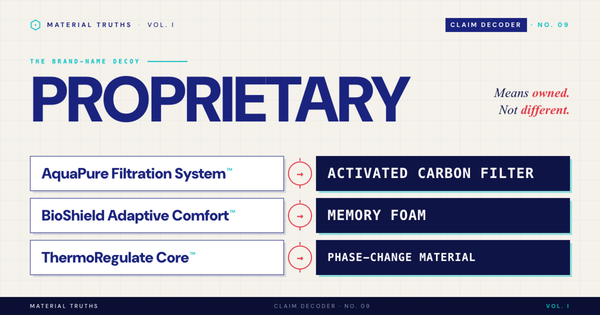
The red flag: Any "proprietary technology" without a patent number. Real patents are findable at USPTO.gov. A brand that cannot produce one is almost certainly using a trademarked name for a commodity material.
Why it works: The five tactics — trademarked names for commodity materials, "studied" instead of "proven," in-house tests framed as research, vague institutional references, and technical jargon — all produce a credibility signal that survives a glance but not a search.
→ Read the full breakdown: Sciencewashing: What It Is, How to Spot It, and Why It Works
2. Proprietary Blend
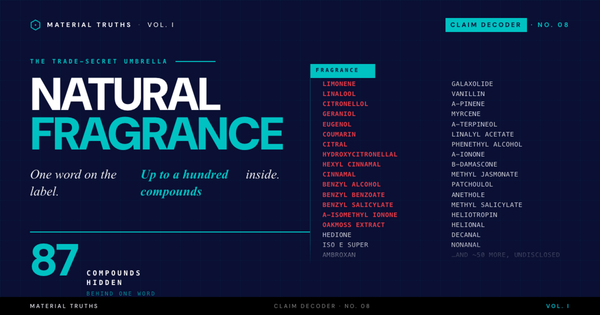
What it is: A proprietary blend is a legally sanctioned way for a supplement or formulation product to list ingredients without disclosing the dose of each one. The brand discloses the total blend weight (e.g., "Energy Matrix Blend — 500 mg") but not how much of each component is actually inside. Trade-secret protection is the stated justification; obscuring underdosed or trivial ingredients is the usual effect.
The red flag: A blend listed in milligrams without per-ingredient amounts. If the most-marketed ingredient is at the bottom of the blend list, FDA labeling rules require it to be present in the smallest amount — often a sprinkle. Brands are not required to tell you this.
Why it works: Consumers assume the marketed ingredient is dosed at a meaningful level. The "proprietary" framing converts a labeling omission into a perceived trade secret.
→ Read the full breakdown: Proprietary Blend: The Legal Meaning and Consumer Implications
3. Patent vs. Trademark
What it is: Patents protect inventions. Trademarks protect names and logos. A trademark says nothing about what a product does, contains, or whether it works — only that the brand has registered a phrase. A ™ symbol is unregistered and requires no review at all; a ® indicates a registered trademark. Neither implies any patented technology.
The red flag: A ™ or ® positioned next to a science-sounding phrase ("ThermaRegulate™," "NanoActive®"). Without a patent number elsewhere on the page, the symbol is protecting marketing language, not an invention.
Why it works: Consumers conflate the symbols. A 2023 academic study found that a majority of shoppers interpret ™ and ® as signals of patented technology. Brands trademark commodity-material names precisely because the symbols are visually similar to the language of innovation.
→ Read the full breakdown: Patent vs. Trademark: Why the Distinction Matters for Product Claims
4. Clinically Tested vs. Clinically Proven
What it is: "Clinically tested" means a product was included in a clinical study. It does not mean the study found a benefit. A brand can truthfully say "clinically tested" even when the study was unblinded, unpublished, methodologically weak, or showed no effect. "Clinically proven" implies demonstrated efficacy — a stronger claim, though even this phrase is not legally defined.
The red flag: "Clinically tested" or "clinically studied" with no citation to a published, peer-reviewed study. Legitimate studies have findable abstracts on PubMed or in the journal that published them.
Why it works: Consumers consistently misremember "tested" and "studied" as "proven." Brands know this and select the weaker phrase deliberately — it is legally defensible while producing the same purchase behavior.
→ Read the full breakdown: Clinically Tested vs. Clinically Proven: The Legal Difference That Matters
Part 2: Social Proof & Reviews
Two patterns exploit a different shortcut: the consumer trust placed in other consumers. When that signal is fabricated, the entire downstream architecture of trust collapses.
5. Fake Reviews
What it is: Fake reviews are paid, incentivized, AI-generated, or fabricated reviews posted on retail sites, social platforms, and brand-owned review widgets. Independent research has estimated that 30–40% of online reviews on major e-commerce platforms are inauthentic. In August 2024, the FTC's new Rule on Consumer Reviews and Testimonials made it explicitly illegal to buy, sell, or generate fake reviews.
The red flag: A cluster of five-star reviews posted within a narrow date window, generic "love it!" phrasing, no specifics about the actual product, and a verified-purchase rate substantially below the platform average. Cross-check on Reddit before purchase; authentic friction tends to surface there first.
Why it works: Reviews compress a complex purchase decision into a single number. Once that number is gameable, every other claim on the page becomes harder to evaluate.
→ Read the full breakdown: Fake Reviews: Detection, Prevalence, and the FTC's 2024 Rule
6. Astroturfing
What it is: Astroturfing is the manufacturing of fake grassroots support — paid accounts presenting as ordinary consumers, undisclosed influencer relationships, comment-section campaigns engineered to look organic, and "communities" built around a product but operated by the brand. The FTC's Endorsement Guides require material connections to be clearly disclosed; astroturfing operates by concealing them.
The red flag: Multiple accounts with similar posting cadence, near-identical language about a product, recent account creation dates, and conspicuous absence of any other content. If the "community" is curated, moderated, or hosted by the brand, treat its endorsement weight as zero.
Why it works: A single influencer is suspect; a chorus of "ordinary consumers" is not. Astroturfing exploits the same heuristic that makes legitimate word-of-mouth so effective — and is significantly cheaper than earning either.
→ Read the full breakdown: Astroturfing: Fabricated Grassroots Marketing and How to Detect It
Part 3: Origin & Ownership
Three patterns operate on a different axis entirely: not what the product is, but who is behind it and where it actually comes from. These are the patterns that turn a TikTok Shop ad into a $40 charge for a product manufactured for $0.80 and shipped from a warehouse the brand has never visited.
7. Made in USA
What it is: Under the FTC's Made in USA Standard, a product labeled "Made in USA" must be "all or virtually all" made in the United States — meaning final assembly and substantially all significant components must originate domestically. "Assembled in USA" is a much weaker claim: the product can be made from imported components and assembled at any final stage.
The red flag: The visual prominence of "Made in USA" without a country-of-origin disclosure on the actual product, packaging, or compliance page. The 2021 Made in USA Labeling Rule allows the FTC to seek civil penalties of up to $51,744 per violation — recently raised — and enforcement is active.
Why it works: "Made in USA" carries a meaningful price premium across categories. The phrase is precise enough that consumers trust it and ambiguous enough that brands abuse it.
→ Read the full breakdown: Made in USA: FTC Standards and Recent Enforcement
8. Shell Company Consumer Brand
What it is: A shell company consumer brand is a product line operated through a holding LLC — often in Delaware, Wyoming, or Nevada — whose registered ownership reveals nothing about who actually runs the business. Multiple "independent" brands can share one operator. Defunct entities can be relaunched as fresh brands. Bad actors can dissolve and re-form to escape consequences.
The red flag: No founder name, no physical address, no manufacturing facility, and a "team" page populated with stock photography. State business records (free, public, searchable by entity name) typically reveal the legal owner — though the Corporate Transparency Act's beneficial-ownership disclosures, while in effect, have been the subject of ongoing legal challenges and limited public access.
Why it works: The internet collapsed the cost of launching a brand. Shell structures collapse the cost of abandoning one. The same operator can run six brands; if one accumulates negative reviews or enforcement attention, they retire it and continue.
→ Read the full breakdown: Shell Company Consumer Brand: How to Trace a Brand's True Ownership
9. Drop Shipping Scam
What it is: Drop shipping itself is a legitimate fulfillment model. The scam version is the use of a drop-ship workflow to sell mass-produced AliExpress or Temu inventory at a 10–40x markup, behind a brand identity that implies the operator designed, manufactured, or stocks the product. The product the consumer sees is not the product that ships.
The red flag: Stock photography on the product page (reverse-image search the hero image), "shipping from our warehouse" language with no warehouse address, delivery windows of 2–4 weeks for a product marketed as US-based, and an identical product appearing on AliExpress at a fraction of the price.
Why it works: TikTok Shop and similar platforms compress the distance between an ad impression and a checkout to seconds. There is no time to reverse-image search before purchase unless the consumer already knows the pattern.
→ Read the full breakdown: Drop Shipping Scam: How the TikTok Shop Pattern Works
Part 4: Pricing & Sustainability
Two patterns operate on the framing of value itself — what the consumer thinks they're saving, and what the consumer thinks they're contributing to.
10. Anchor Pricing
What it is: Anchor pricing is the display of an inflated "original" or "list" price next to a "sale" price to manufacture the perception of a discount. The technique becomes deceptive when the "original" price was never the actual selling price — never charged, never realized, or maintained only briefly to legitimize a permanent "sale." California's Business and Professions Code §17501 prohibits former-price advertising unless the higher price was the prevailing market price within the preceding three months.
The red flag: A persistent "70% off" structure, a "list price" significantly higher than competitor pricing for identical commodity items, and price history tools (Keepa for Amazon, Honey, browser extensions) that reveal the "original" price was never charged.
Why it works: Discount framing dominates absolute price in consumer decision-making. A $40 product marketed as "$140 — now $40" outsells the same product at "$40" by a substantial margin in most experimental settings.
→ Read the full breakdown: Anchor Pricing: How Brands Manipulate Perceived Discounts
11. Greenwashing
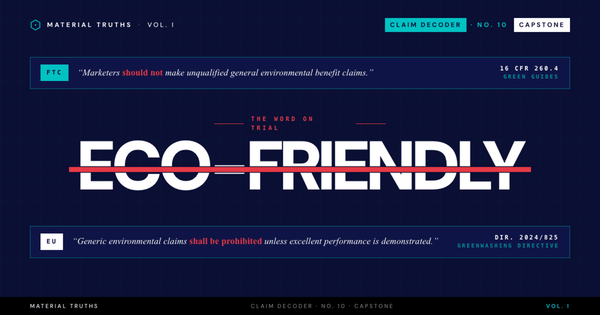
What it is: Greenwashing is the use of environmental, sustainability, or "natural" language to imply ecological benefit where the substantiation is absent, vague, or contradictory. The FTC's Green Guides — currently being updated for the first time since 2012 — set the federal expectations for environmental marketing claims, requiring that terms like "biodegradable," "recyclable," and "non-toxic" be substantiated, qualified, and specific.
The red flag: Unqualified "eco-friendly," "natural," "non-toxic," or "sustainable" without a specific claim attached. Real environmental claims cite a certification body (B Corp, GOTS, FSC), a measurable outcome (carbon footprint, recycled content percentage), or a third-party audit. Marketing that uses green imagery without green substance is doing the work of a claim without the cost of one.
Why it works: Sustainability framing carries premium pricing power, and the costs of substantiation are higher than the costs of suggestion.
→ Read the full breakdown: Greenwashing: Environmental Claim Deception and FTC Enforcement
Part 5: How Enforcement Catches Up
The first eleven patterns are what brands do. The twelfth is what happens — sometimes, eventually — when they do it long enough.
12. FTC Consent Order
What it is: A consent order is a binding settlement agreement between the Federal Trade Commission and a company accused of unfair or deceptive practices. The company typically does not admit guilt but agrees to specific conduct restrictions, monetary penalties (often in the millions), monitoring requirements, and a 20-year compliance window during which violations carry per-incident civil penalties — currently up to $51,744 per violation, with the cap adjusted annually for inflation.
The red flag: A brand with a prior consent order should be treated as a brand with a documented pattern. Consent orders are public; the FTC maintains a searchable database at ftc.gov. Recent high-profile examples include Prevagen (memory supplement claims), Sunday Riley (employee-authored fake reviews), and Rytr (AI-generated fake reviews — order subsequently vacated on First Amendment grounds).
Why it matters: Consent orders are the consumer's clearest signal that a brand's marketing has already required federal correction. The same operator does not usually become a different operator after settlement; the playbook moves to a new product line.
→ Read the full breakdown: FTC Consent Order: How Federal Settlements Actually Work
The 60-second verification routine
The twelve patterns above share a structural feature: each one survives a glance, and almost none survive a primary-source check. Before any consumer purchase over roughly $40 — and before any TikTok Shop purchase regardless of amount — the following routine collapses most deception in under a minute.
- USPTO.gov — search any patent number cited. If none is cited but the product is marketed as patented, that is the answer.
- Brand name + "FTC" — and brand name + "NAD" — to surface prior enforcement or self-regulatory rulings.
- State business records (Wyoming, Delaware, Nevada, California) — search the legal entity name. Confirm the operator is who the marketing implies.
- Reverse image search the product hero shot. AliExpress and Temu listings tend to surface immediately.
- Reddit the brand name. Unfiltered consumer experience surfaces here before it does on review platforms.
If a brand cannot survive sixty seconds of structured scrutiny, it should not survive the purchase decision.
Frequently asked questions
What is consumer deception in marketing?
Consumer deception in marketing is the use of claims, imagery, or framing that creates a misleading overall impression about a product — even when no single statement is literally false. The Federal Trade Commission evaluates deceptive advertising based on the "overall net impression" a reasonable consumer takes from an advertisement as a whole, not on isolated literal statements. Most deception falls into a small number of repeating patterns rather than novel fabrications.
What are the most common deceptive marketing patterns in consumer products?
Material Truths documents twelve recurring patterns: sciencewashing, proprietary blends, patent vs. trademark conflation, clinically tested vs. clinically proven framing, fake reviews, astroturfing, false "Made in USA" claims, shell company consumer brands, drop shipping scams, anchor pricing, greenwashing, and unresolved FTC consent order histories. Most deceptive product pages combine three or more of these patterns simultaneously.
How can consumers verify a brand's claims before buying?
Use the 60-second verification routine above: check USPTO.gov for any patent or trademark numbers, search the brand name plus "FTC" or "NAD" for prior enforcement, look up the legal entity in state business records, reverse-image-search the product photo, and search Reddit for unedited consumer experience. If a brand cannot produce primary-source evidence for a specific claim within one minute, the claim should be treated as unsubstantiated.
Is deceptive marketing illegal?
Yes. Section 5 of the Federal Trade Commission Act prohibits unfair or deceptive acts or practices in commerce. State consumer protection statutes — including California's Consumers Legal Remedies Act and New York's General Business Law §349 — provide additional enforcement pathways, often through class action litigation. However, enforcement is reactive: most deception is documented only after consumers have already been harmed, which is why pre-purchase verification matters more than post-purchase remedies.
Why are deceptive marketing patterns so common on TikTok Shop and DTC sites?
Platform incentives reward velocity over verification. TikTok Shop, Amazon, and direct-to-consumer storefronts allow brands to launch with no track record, no verifiable corporate history, and no advertising standards review. The same patterns the FTC has spent decades regulating in television advertising appear unmoderated in social commerce. Shell company structures further insulate operators from reputational consequences, allowing the same playbook to be relaunched under new brand names.
What is the difference between sciencewashing and greenwashing?
Greenwashing specifically refers to misleading environmental or sustainability claims. Sciencewashing is the broader practice of using scientific-sounding language, trademarked terminology, and cherry-picked data to create false impressions of efficacy or innovation. The two overlap frequently — a product can be both sciencewashed and greenwashed when "eco-clinical" or "sustainable bioactive" framing is used to dress up commodity ingredients.
How Material Truths investigates these patterns
Every Material Truths investigation runs through a 12-step methodology built around these patterns: USPTO patent and trademark verification, corporate entity tracing across state LLC registrations, EPA registration verification where applicable, pricing structure forensics, and cross-referenced review authenticity analysis. The pattern library above is the lens; the methodology is the camera.
If a brand or product page contains language matching any of the twelve patterns, send it to Material Truths via our tips form. Anonymous submissions accepted. All claims verified against primary sources before publication.
Material Truths is an independent consumer investigation publication. We have no advertising relationships, no sponsorships, and no financial ties to any brand we cover. Read our editorial standards →