Drop Shipping Scams: How to Spot AliExpress Markup Schemes and TikTok Shop Fraud

Last updated: May 3, 2026
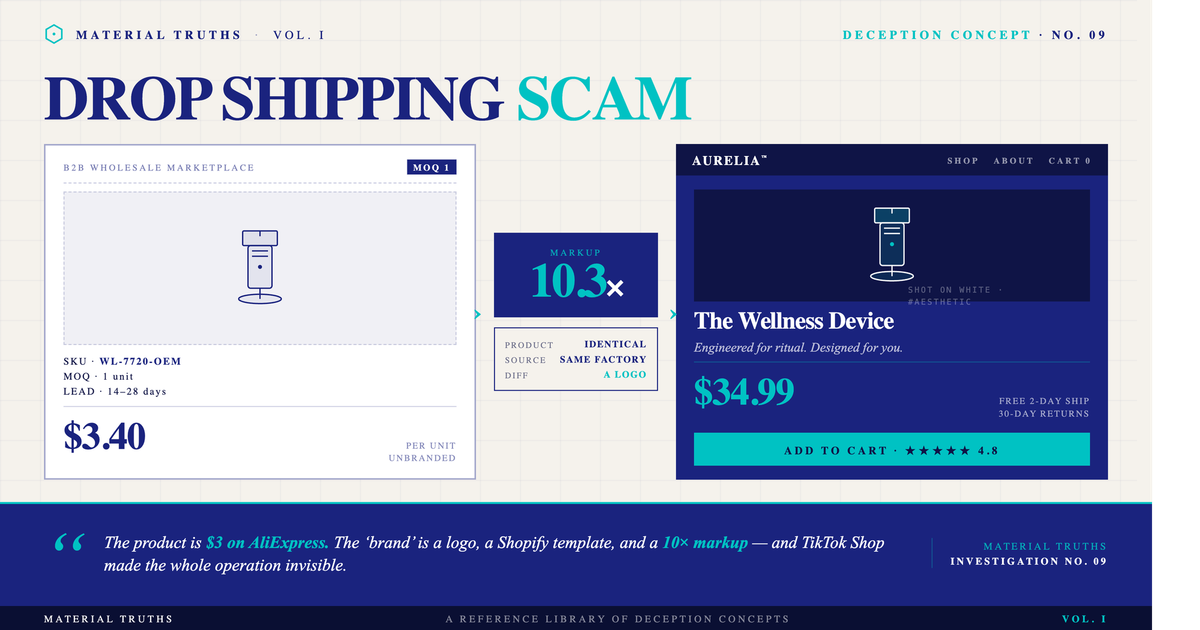
Drop shipping scams take commodity products from AliExpress, Temu, or Alibaba, wrap them in branded storefronts, and resell them at 5 to 10 times wholesale cost using paid creator content and fabricated brand stories. The fulfillment model itself is legal — what turns it into a scam is the deceptive representation of commodity products as distinctive branded ones. TikTok Shop's rapid growth has made this pattern pervasive, with U.S. sellers on the platform expanding from approximately 4,450 in 2023 to over 475,000 by 2025.
What is drop shipping and when does it become a scam?
Drop shipping is a fulfillment model. A seller accepts orders from customers, forwards those orders to a supplier or manufacturer, and the supplier ships the product directly to the customer. The seller never handles inventory. Thousands of legitimate businesses use drop shipping for reasonable reasons: lower inventory risk, faster scaling, reduced capital requirements.
The model becomes a scam when it crosses into misrepresentation. Specifically:
- When commodity products are presented as proprietary brand-specific products
- When origin claims are fabricated — for example, "Made in USA" or "Designed in California" for products shipped directly from Chinese manufacturers
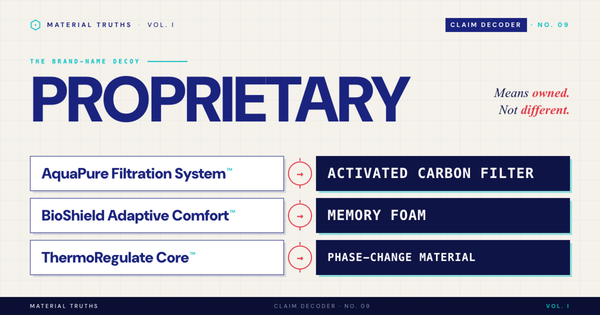
- When marketing implies technology, patents, or innovation that exists only in the trademarked name
- When customer expectations about the product, brand, or shipping origin are deliberately distorted
- When the same underlying product is sold simultaneously by multiple "brands" at widely varying markups
Drop shipping itself is not deceptive. Drop shipping combined with brand fabrication, origin lies, patent claims the underlying product cannot support, or price anchoring is where the legal and ethical problems concentrate.
How does the TikTok Shop drop shipping pattern work?
The pattern has become standardized enough to be reliably identifiable. Common steps:
1. Source identification. An operator browses AliExpress, Temu, or Alibaba for products with high perceived value relative to wholesale cost. Categories with the highest margins for this pattern include beauty and skincare, home and kitchen gadgets, cooling products (bedding, apparel), jewelry, supplements, and pet products. Typical wholesale cost: $2 to $8 per unit.
2. Branded storefront creation. The operator builds a Shopify store using common templates (Debutify, Brooklyn, or dropship-specific themes) or opens a TikTok Shop account. A brand name is invented rather than trademarked first. The domain is registered via Shopify or a registrar, typically within the past 3 to 6 months.
3. Product page construction. Product photos are lifted from the AliExpress supplier's listing, sometimes with minor modifications. Descriptions are generated with marketing copy emphasizing proprietary-sounding features like "NanoCool™ technology," "hospital-grade," or "patented design" for products that carry none of these attributes.
4. Marketing content production. Creators are paid (typically $50 to $500 per post) to produce TikTok or Instagram content that presents the product as a personal discovery. The FTC's Endorsement Guides require disclosure, but compliance varies.
5. Fulfillment routing. Orders placed through the branded store are routed to the AliExpress or Temu supplier, who ships directly. Shipping typically takes 10 to 30 days. Customer communication often includes vague language about "shipping delays" or "production times" rather than acknowledging the actual origin.
6. Price capture. The consumer pays the branded price (often $30 to $80) for a product that cost the operator $2 to $8 wholesale. The 5 to 10x markup funds marketing, platform fees, returns, and operator margin.
7. Brand rotation. When return rates spike, reviews turn negative, or platform enforcement escalates, operators abandon the brand and create a new one. The same AliExpress product reappears under a new brand name within weeks.
What are the red flags of a drop shipping store?
A practical checklist:
| Red flag | How to check |
|---|---|
| Shipping times 10+ days for "domestic" brand | Check shipping policy and tracking |
| Product photos match AliExpress or Temu | Reverse image search |
| Brand domain registered recently | whois.com domain registration date |
| No physical address | "About Us" page, contact page |
| No founder information | About page, LinkedIn search |
| Vague manufacturing claims | "About Us" specifics |
| Generic brand name | Google the name — does anything predate the store? |
| Identical products at multiple "brands" | Search AliExpress for the product |
| Customer service only via email | Contact page options |
| Returns extremely difficult | Return policy specifics |
| Shopify template indicators | View page source code |
| No trademark registration | USPTO TSDR at tsdr.uspto.gov |
A brand with many of these indicators is not necessarily fraudulent — some legitimate small businesses share some traits. But seven or more indicators together is a strong signal of the drop ship pattern.
How can consumers reverse-check a drop shipping product?
The fastest verification is reverse image search.
- Save a product photo. Right-click → Save Image.
- Google Images reverse search. Upload the saved image at images.google.com.
- TinEye reverse search. Repeat at tineye.com — TinEye sometimes finds matches Google misses.
- Yandex reverse search. Yandex's image search often has the strongest AliExpress coverage, at yandex.com/images.
If the same product appears on AliExpress, Temu, Alibaba, DHgate, or similar wholesale platforms at a fraction of the retail price, the listing is a drop ship operation.
Additional checks:
- Domain age. Search whois.com for the brand's domain. If registered in the past 6 months and the brand claims "years of experience" or similar, the claim is false.
- Google the brand + "AliExpress." Consumer forums and Reddit often identify drop ship operations with specific brand-to-AliExpress matches.
- Trademark status. A legitimate brand typically has USPTO trademark registration. No trademark on a brand claiming proprietary technology is a strong signal.
- Shipping origin reports. If consumers report receiving packages from China despite the brand claiming U.S. fulfillment, the origin claim is fabricated.
Is drop shipping illegal?
The fulfillment model is legal. What becomes illegal is misrepresentation. Legal violations that commonly accompany drop shipping scams include:
- False advertising under FTC Act Section 5. Claims about the product, its origin, its manufacturing process, its patent status, or its proprietary nature that are not true.
- Made in USA Labeling Rule violations. When drop shippers claim U.S. origin for products shipped from Chinese manufacturers. Civil penalties up to $53,088 per violation.
- Consumer Reviews and Testimonials Rule violations. Paid creator content without disclosure; fake review networks; manufactured social proof.
- State consumer protection violations. California's Consumers Legal Remedies Act, New York's General Business Law §349, and similar state statutes enable class actions for deceptive representation.
- Trademark infringement. When drop shippers use trademarked terms without authorization.
- Patent marking violations under 35 U.S.C. §292. When drop shippers claim "patented" technology without any actual patent.
The FTC does not typically bring cases labeled as "drop shipping scams" — enforcement happens under the underlying false advertising and consumer protection theories. The outcome for consumers is the same: marketed products can be deceptive regardless of fulfillment model.
Recent enforcement on deceptive drop shipping
Enforcement patterns observed across 2024-2026:
- FTC consumer protection actions. Multiple FTC cases have targeted drop shipping operations for false product claims, fake reviews, and Made in USA violations. Cases typically involve multiple false advertising theories rather than drop-shipping-specific charges.
- Platform enforcement. Amazon, TikTok Shop, Shopify, and Meta have all taken enforcement actions against drop shipping operations violating platform terms. Platform enforcement typically results in account closure rather than consumer remedies.
- Class action litigation. Class actions against drop ship operations have succeeded on fraud, warranty, and state consumer protection theories. Challenges include locating and serving operators who often operate through multiple dissolved LLC shells.
- State attorney general actions. State AGs in California, New York, Washington, and Massachusetts have brought cases against drop ship operations making false origin or product claims.
This section is updated as new enforcement actions are documented.
Frequently asked questions
What is drop shipping and when does it become a scam? Drop shipping is a legal fulfillment model; it becomes a scam when commodity products are misrepresented as proprietary, origin claims are fabricated, or marketing asserts attributes the product lacks.
How does the TikTok Shop drop shipping pattern work? Operator identifies cheap AliExpress product, creates branded storefront, produces paid creator content, ships direct from Chinese supplier at 5-10x markup.
What are the red flags? Long shipping times, matching AliExpress/Temu product photos, recent domain registration, vague brand information, identical products at multiple "brands," no trademark.
How can I reverse-check a product? Google/TinEye/Yandex reverse image search, whois.com domain age check, trademark search at USPTO, Google "brand name + AliExpress."
Is drop shipping illegal? Not inherently. Deceptive drop shipping violates FTC Act Section 5, state consumer protection laws, and potentially Made in USA and Consumer Reviews Rules.
What enforcement exists? General false advertising enforcement under FTC Act Section 5 and state law, not drop-shipping-specific regulation.
Further reading
- Shell Company Consumer Brand: How drop shippers use LLC structures
- Anchor Pricing: Price manipulation that often accompanies drop shipping
- Made in USA: False origin claims common in drop shipping
- Fake Reviews: Manufactured social proof often supports drop shipping
Sources
- FTC. "Made in USA Labeling Rule." 16 CFR Part 323.
- FTC. "Consumer Reviews and Testimonials Rule." 16 CFR Part 465.
- FTC. "Advertising FAQs: A Guide for Small Business." ftc.gov
- USPTO Trademark Status and Document Retrieval. tsdr.uspto.gov
- 35 U.S.C. §292 — False marking statute.