Clinically Tested vs. Clinically Proven

Last updated: April 28, 2026
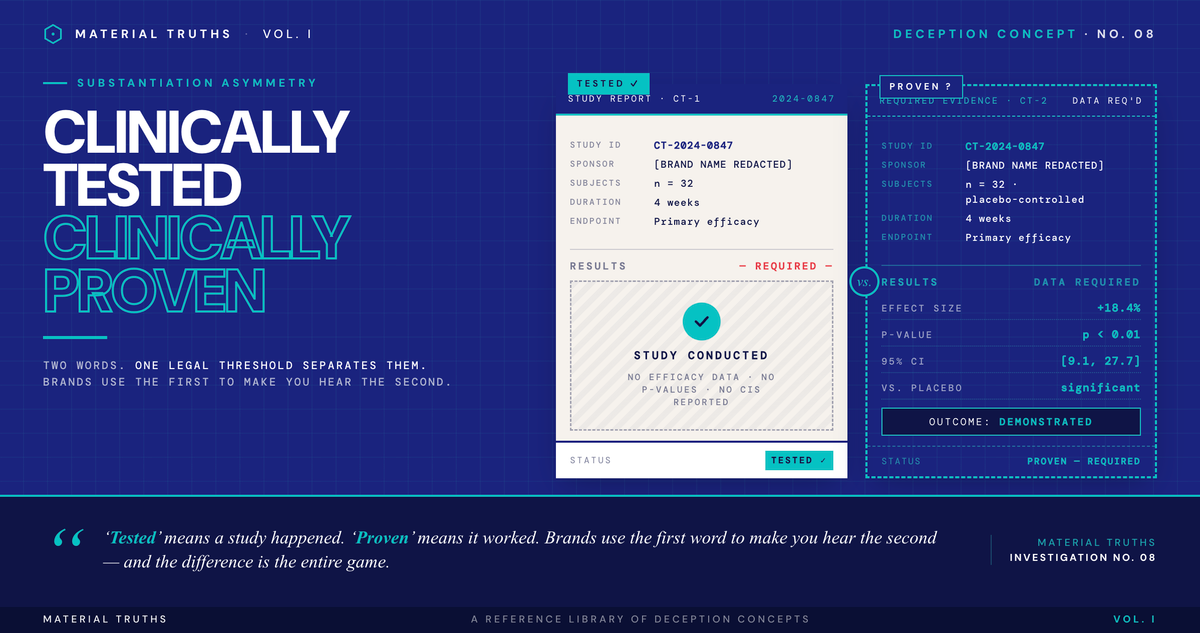
"Clinically tested" means a product was included in clinical testing — it says nothing about whether the product worked. "Clinically proven" implies demonstrated efficacy. Consumers typically treat the two as equivalent, which is exactly why brands use "tested" to get the credibility benefit of "proven" with lower substantiation burden. Neither term has a precise legal definition, but both are regulated under the FTC's prior substantiation doctrine. Understanding the distinction is the single most important vocabulary lesson for evaluating skincare, supplement, and wellness marketing.
What does "clinically tested" mean?
"Clinically tested" describes the occurrence of testing, not the outcome. A brand can truthfully label a product "clinically tested" after:
- Including the product in any form of clinical study
- Conducting internal testing with participants
- Running a study that found no benefit
- Running a study that found negative results
- Running a study that was never completed
- Running a study that was never published
- Running a study funded entirely by the brand itself
None of the above would prevent the brand from accurately claiming the product is "clinically tested." The claim speaks only to whether testing happened, not whether it demonstrated anything.
Related phrases with similar weak substantiation requirements:
- "Clinically studied" — roughly equivalent to "clinically tested"
- "Laboratory tested" — even weaker; may refer to in vitro tests with no human relevance
- "Research-backed" — vague; may refer to research on any related topic, not the specific product
- "Science-based" — rhetorical, not substantiated
- "Dermatologically tested" — for skincare; tested at some point by dermatologists, with no outcome implication
What does "clinically proven" mean?
"Clinically proven" carries a stronger implication. Consumers reasonably interpret it as meaning the product has been shown to work in clinical settings. The term implies efficacy has been established, not merely investigated.
The term is not legally defined in U.S. law. But because consumer interpretation treats it as an efficacy claim, the FTC applies prior substantiation requirements — a brand using "clinically proven" must have competent and reliable scientific evidence showing the product actually does what the claim suggests.
This creates the asymmetric incentive. "Tested" requires that any study have occurred. "Proven" requires evidence that the study demonstrated the claim. Brands get similar marketing benefit from either term while having vastly different substantiation exposure.
What's the legal difference?
Neither term has a specific legal definition. Both are governed under:
- FTC Act Section 5 (prior substantiation): Advertisers must have a reasonable basis for objective claims before making them. For health, efficacy, and technology claims, this typically requires competent and reliable scientific evidence.
- FDA regulations: For specific health claims (heart disease risk, cancer risk, etc.), FDA pre-approval is required with specific language. The phrases "clinically tested" and "clinically proven" are not themselves FDA-regulated unless they're used in connection with a regulated health claim.
- State consumer protection laws: California's Consumers Legal Remedies Act, New York General Business Law §349, and similar statutes enable class actions when clinical claims are unsupported.
The FTC's position: technically accurate claims can still be deceptive when the overall impression misleads consumers. A product truthfully labeled "clinically tested" can still face FTC action if the marketing context implies the testing proved efficacy when it did not.
Why do brands prefer "clinically tested"?
Three reasons:
1. Lower substantiation burden. Brands can commission any study, produce any results, and still truthfully claim "clinically tested" afterward. The FTC substantiation requirement for "tested" is satisfied simply by conducting a study.
2. Reduced litigation exposure. Class action plaintiffs challenging "clinically proven" claims can examine the underlying evidence and argue the evidence doesn't support efficacy. Challenging "clinically tested" is harder because the claim doesn't assert efficacy.
3. Consumer interpretation gap. Consumers largely treat the two terms as interchangeable. Multiple consumer research studies have found that majorities of surveyed consumers interpret "clinically studied" and "clinically proven" as equivalent in meaning. This means brands using the weaker term get the credibility benefit of the stronger term.
The asymmetry is well-documented in marketing research circles and openly discussed in industry publications. The legal profession has repeatedly flagged the practice as vulnerable to enforcement action, but enforcement has been inconsistent.
How consumers consistently misinterpret these terms
The interpretation gap drives the marketing strategy. In consumer research:
- Most consumers do not consciously distinguish "tested" from "proven"
- Post-exposure recall of marketing claims often shifts weaker terms ("studied") toward stronger interpretations ("proven")
- Visual accompaniment — clinical imagery, scientific charts, lab coats — amplifies the interpretation shift
- The presence of any scientific-sounding language significantly affects purchase intent regardless of the specific term used
This research has been known to both regulators and advertisers for decades. The FTC has acknowledged the gap in various guidance documents. But enforcement specifically targeting the "tested vs. proven" language distinction has been limited, leaving the practice widespread.
How to verify clinical claims
A practical verification workflow:
- Request the study citation. A brand making clinical claims should be able to cite the specific study. If the response is vague or references proprietary internal data, the claim should be treated skeptically.
- Find the study on PubMed. Peer-reviewed clinical research is indexed on PubMed (pubmed.ncbi.nlm.nih.gov). If the study isn't findable, it may not have been published or peer-reviewed.
- Check funding and conflict-of-interest disclosures. Published studies disclose funding sources. Brand-funded studies aren't invalid but warrant additional scrutiny.
- Evaluate sample size and control design. Small studies (under 50 participants), uncontrolled studies, and studies without placebo controls produce weaker evidence than large controlled trials.
- Match claim to evidence. Did the study actually test the specific claim the brand is making? A study showing a skincare ingredient improves hydration does not support a claim that it reduces wrinkles.
- Check study registration. Clinical trials on human subjects should typically be pre-registered at ClinicalTrials.gov. Pre-registration creates accountability for outcomes; unregistered studies are more susceptible to selective reporting.
Recent enforcement on clinical claims
FTC and NAD enforcement on clinical claims is common but typically focuses on broader false advertising rather than the specific "tested vs. proven" distinction. Cases often result in brands modifying claim language to use "tested" more carefully.
Class action litigation has targeted:
- Skincare brands using "clinically proven" for products lacking controlled efficacy studies
- Supplement brands using "clinically studied" with reference to studies on different ingredients than the finished product
- Oral care products using clinical language for claims beyond what studies supported
This section is updated as new relevant enforcement actions are documented.
Frequently asked questions
What does "clinically tested" mean? A product was included in clinical testing — nothing about the testing outcome.
What does "clinically proven" mean? Efficacy has been demonstrated in clinical studies. Strong consumer interpretation; no precise legal definition but enforced under FTC prior substantiation.
What's the legal difference? Neither has a statutory definition. Both are governed by FTC prior substantiation requirements and state consumer protection laws. "Proven" requires substantive evidence of efficacy.
Why do brands prefer "clinically tested"? Lower substantiation burden, reduced litigation exposure, and consumer interpretation gap that provides credibility benefit of "proven" without the evidence requirement.
Do consumers understand the difference? Research consistently finds most consumers interpret the two terms as equivalent.
How can I verify clinical claims? Request study citations, check PubMed, evaluate funding disclosures, match claim to evidence, check study registration at ClinicalTrials.gov.
Further reading
- Sciencewashing: Broader pattern that this specific language trick fits into
- Claims decoder: "Clinical-Grade": Related adjacent term
- Claims decoder: "Dermatologist-Tested": Similar weak-substantiation phrase
Sources
- FTC Act Section 5, 15 U.S.C. § 45.
- FTC. "Dietary Supplements: An Advertising Guide for Industry." ftc.gov/business-guidance/resources/dietary-supplements-advertising-guide-industry
- FTC. "Advertising FAQs: A Guide for Small Business." ftc.gov
- PubMed. pubmed.ncbi.nlm.nih.gov
- ClinicalTrials.gov. clinicaltrials.gov
Get notified when we add new enforcement examples to this page.