What "Clinical-Grade" Legally Means (Mostly Nothing, and Here's Why)

Last updated: May 23, 2026
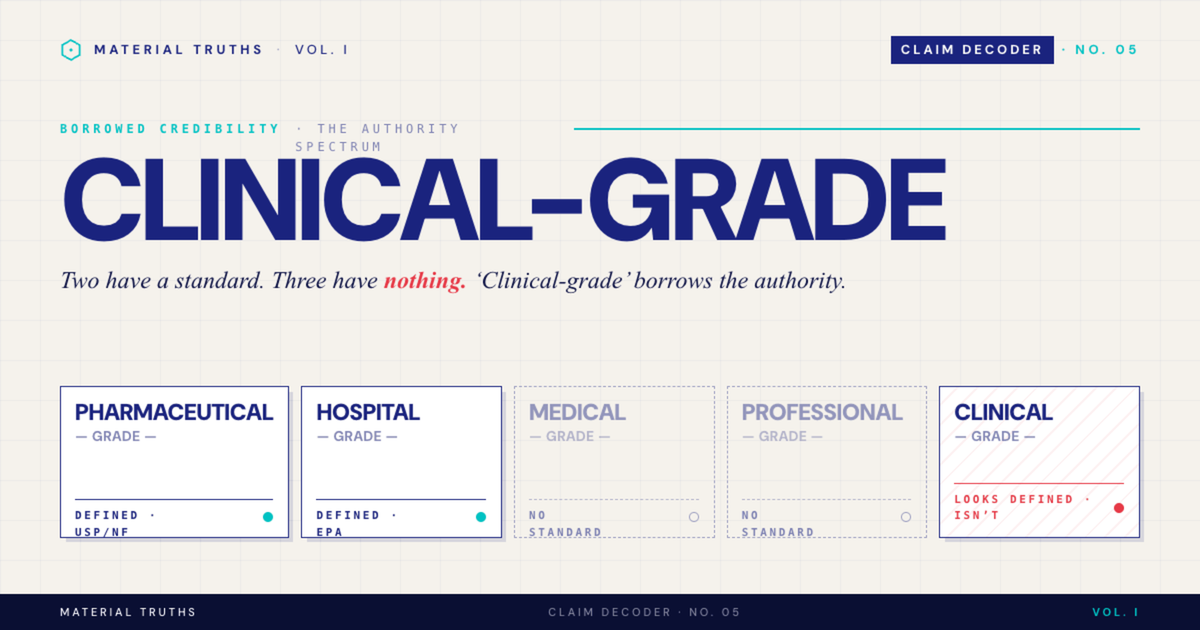
"Clinical-grade" has no legal definition in U.S. consumer product regulation. The term is marketing language that implies medical or pharmaceutical quality without referencing any specific standard. Related terms — "pharmaceutical-grade," "hospital-grade," "medical-grade," "professional-grade" — vary significantly in their regulatory meaning. Some have real standards behind them; most do not. This decoder distinguishes which "-grade" claims mean something verifiable and which are pure marketing.
What does "clinical-grade" actually mean?
Nothing, as a regulatory matter. No FDA, FTC, or other federal agency has defined "clinical-grade" for consumer products. Brands can apply it to:
- Supplements and nutraceuticals
- Skincare and cosmetics
- Bedding and home goods
- Personal care devices
- Essential oils and wellness products
- Food products
...all without meeting any specific quality standard. The term functions as an implication that the product meets standards used in medical or clinical settings — but the implication requires no substantiation by default.
When "clinical-grade" appears on a product, it means only that the brand chose to use the term. It does not indicate:
- That the product was manufactured to pharmaceutical standards
- That ingredients were verified against USP or NF specifications
- That the product was tested in a clinical setting
- That any clinician evaluated or endorsed the product
- That the product meets any measurable criterion
The "-grade" claim landscape
Not all "-grade" claims are equivalent. Some reference real standards. Most don't.
Terms with actual standards behind them:
- USP-grade / USP-verified. References the United States Pharmacopeia, which maintains published quality standards for drugs, ingredients, and dietary supplements. USP-verified products are independently tested by USP and carry a verifiable seal. The USP website at usp.org lists certified products.
- NF-grade. References the National Formulary, a companion publication to USP covering pharmaceutical ingredients not in USP. Real specification.
- NSF-certified. Not technically a "-grade" term but functions similarly. NSF International (nsf.org) is a third-party certifier with specific testing protocols for supplements (NSF Certified for Sport), water systems, food equipment, and other categories.
- GMP-compliant. References Good Manufacturing Practices, which FDA enforces for supplements under 21 CFR Part 111. A specific regulatory compliance standard.
- EPA-registered. For pesticides and antimicrobials. Specific registration with efficacy data required.
- Hospital-grade disinfectant. Specific to EPA-registered disinfectants. Requires demonstrated efficacy against Staphylococcus aureus, Salmonella enterica, and Pseudomonas aeruginosa. Cannot legitimately be used on non-disinfectant products.
Terms with no regulatory meaning:
- Clinical-grade. No definition. No standard. No verification required.
- Medical-grade. Sometimes references medical device classifications (Class I, II, III) but often used loosely on non-device consumer products.
- Pharmaceutical-grade. In industry contexts, generally understood to reference USP/NF specifications. In consumer marketing, often used without any verifiable standard. Brands using this term legitimately should identify the USP monograph.
- Professional-grade. No definition.
- Industrial-grade. No regulatory meaning outside specific industrial equipment categories.
- Lab-grade / laboratory-grade. Has meaning in laboratory supply contexts (reagent chemicals, etc.) but is undefined on consumer products.
- Research-grade. No consumer product definition.
Pharmaceutical-grade vs. clinical-grade
Pharmaceutical-grade is the term most frequently conflated with clinical-grade in consumer marketing. The distinction:
Legitimate pharmaceutical-grade typically means ingredients meet specifications published in:
- United States Pharmacopeia (USP). Maintains compendial standards for drugs and ingredients. USP monographs specify identity, purity, strength, and quality tests.
- National Formulary (NF). Companion to USP for additional ingredients.
- European Pharmacopoeia (Ph. Eur.) or other international pharmacopeias for products made to those standards.
A supplement or ingredient marketed as pharmaceutical-grade should be able to identify which specification it meets. A legitimate response looks like: "Our magnesium citrate meets USP-34 monograph specifications for magnesium citrate, tested for [specific attributes]." A non-legitimate response is silence, or vague assurance without specification.
Clinical-grade has no such anchor. A product marketed as clinical-grade but not pharmaceutical-grade, NSF-certified, or USP-verified likely has no specific standard behind the term.
Hospital-grade has an actual meaning (for disinfectants)
One "-grade" claim worth understanding separately is "hospital-grade," because it does have regulatory meaning in a specific context.
Under EPA pesticide regulation, "hospital-grade disinfectant" is defined by the pathogens the product must kill:
- Staphylococcus aureus
- Salmonella enterica
- Pseudomonas aeruginosa
Products claiming hospital-grade disinfectant status must be EPA-registered with submitted efficacy data demonstrating effectiveness against all three organisms. Consumers can verify by searching the EPA Pesticide Product Label System at iaspub.epa.gov/apex/pesticides/f?p=PPLS:1.
The term is frequently misused on non-disinfectant products — bedding, towels, water bottles, personal care items — where it has no regulatory meaning. These uses are unregulated marketing language, not verified quality claims.
How can consumers verify "clinical-grade" claims?
Because the term has no legal definition, verification depends on identifying what (if anything) substantiates it. Questions to ask:
1. Does the brand cite a specific quality standard? USP, NF, NSF, USDA Organic, OEKO-TEX — all are verifiable. Silence on this question signals pure marketing.
2. Does the product hold third-party certifications?
- NSF Certified for Sport: supplements tested for contaminants and label accuracy
- USP Verified: supplements meeting USP standards
- Informed Sport: verified against prohibited substances
- OEKO-TEX STANDARD 100: textiles tested for harmful substances
3. Are cited clinical studies verifiable? Legitimate clinical references include study title, authors, journal, and year. Search PubMed (pubmed.ncbi.nlm.nih.gov). If the study doesn't appear, the citation may be fabricated.
4. Is the manufacturing facility GMP-compliant? FDA inspects supplement manufacturers for 21 CFR Part 111 compliance. A brand confident in its manufacturing will disclose GMP certification.
5. Is the clinical claim qualified appropriately? A product "used in clinical settings" is different from a product "clinical-grade." Specific use cases can be factually disclosed; quality grades require specific standards.
When "clinical-grade" crosses into deception
"Clinical-grade" alone isn't deceptive per se — it's just vague. It becomes deceptive when combined with specific substantive claims that imply it means something it doesn't:
- "Clinical-grade formula proven to [specific outcome]" — the proven outcome claim requires substantiation regardless of the clinical-grade framing
- "Clinical-grade purity" — implies a quality standard; brand should identify which one
- "Clinical-grade antimicrobial" — implies EPA-level efficacy; triggers FIFRA scrutiny if public health claims are being made (see our page on antimicrobial claims)
- "Clinical-grade cold-pressed" — the specific process claim can be evaluated; the clinical-grade framing is decorative
FTC Act Section 5 enforcement targets the underlying substantive claims rather than the "grade" language. NAD proceedings have challenged clinical-grade claims when accompanying specific product assertions lack substantiation.
Frequently asked questions
What does "clinical-grade" mean on a consumer product? Nothing specific. It has no legal definition.
Is "clinical-grade" the same as "pharmaceutical-grade"? No. Pharmaceutical-grade typically references USP/NF specifications; clinical-grade has no standard.
Is "hospital-grade" regulated? Only for disinfectants, under EPA pesticide registration requiring efficacy against Staphylococcus aureus, Salmonella enterica, and Pseudomonas aeruginosa.
Can supplements claim to be "clinical-grade"? Yes — no regulation prevents it. Substantive claims accompanying the label must still meet FTC substantiation requirements.
How can consumers verify? Look for specific standards cited: USP-verified, NSF-certified, GMP-compliant, EPA-registered. These have actual verification.
Similar terms with legal meaning? USP, NF, NSF-certified, GMP-compliant, EPA-registered, OEKO-TEX STANDARD 100.
Further reading
- Sciencewashing: The broader pattern
- Clinically Tested vs. Clinically Proven: Related substantiation language
- Claim decoder: "FDA-Registered": Related regulatory-sounding term
- Claim decoder: "Antimicrobial": Where hospital-grade has real meaning
Sources
- U.S. Pharmacopeia. "USP Verified Mark Program." usp.org/verification-services/verified-mark
- NSF International. "Certified for Sport." nsfsport.com
- FDA. "Current Good Manufacturing Practice in Manufacturing, Packaging, Labeling, or Holding Operations for Dietary Supplements." 21 CFR Part 111.
- EPA Pesticide Product Label System. iaspub.epa.gov/apex/pesticides/f?p=PPLS:1
- FTC. "Dietary Supplements: An Advertising Guide for Industry." ftc.gov