What "Dermatologist Tested" Actually Means (And Why It's Not Much)

Last updated: May 24, 2026
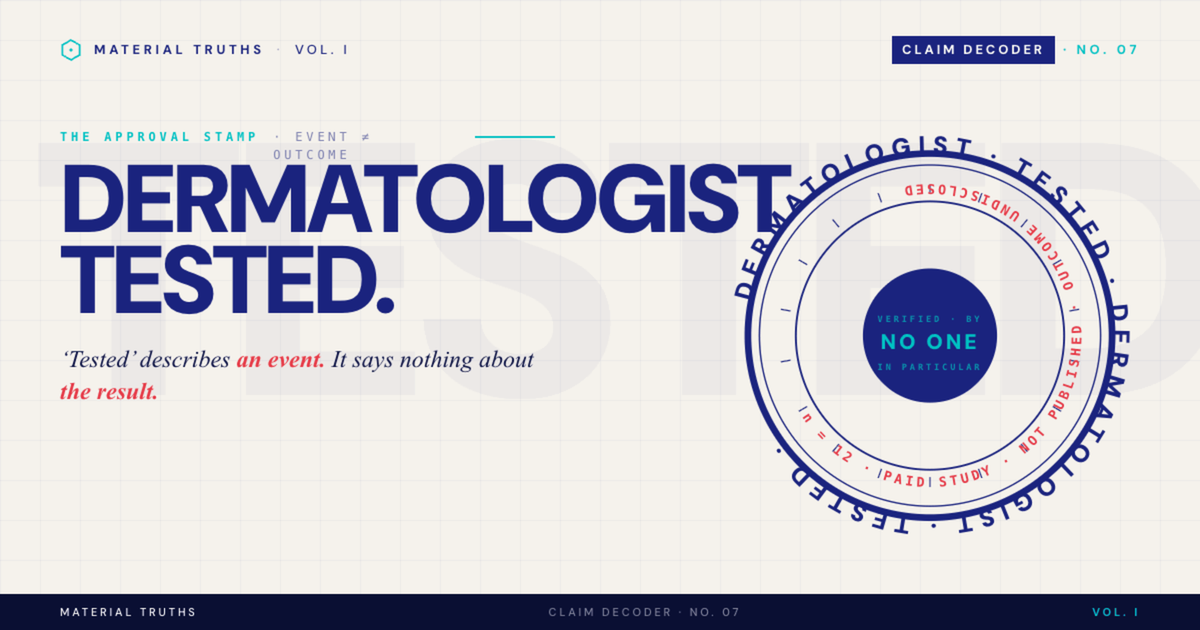
"Dermatologist tested" means a dermatologist tested the product. It does not describe the outcome of the testing, the sample size, the duration, the testing protocol, or whether the tested product was found safe or effective. The term has no legal definition under FDA or FTC regulations — a brand can truthfully use it after any form of dermatologist involvement, regardless of results. Related claims like "dermatologist recommended," "dermatologist approved," and "allergy tested" operate the same way.
What does "dermatologist tested" actually mean?
The claim describes an event (testing occurred) without describing the result (what the testing showed). A product can be truthfully labeled "dermatologist tested" when:
- A dermatologist observed testing with any sample size
- The testing found significant skin irritation
- The testing was inconclusive
- The testing protocol was not peer-reviewed
- The dermatologist was paid by the brand
- The testing occurred on a preliminary formulation that was later changed
- The results were never published or made public
The FDA does not regulate the term. The FTC does not pre-approve the term. No governmental body verifies the existence or rigor of the testing. Brands are subject to FTC Act Section 5 prohibitions on deceptive advertising if they make specific substantive claims the testing does not support, but the bare "dermatologist tested" label operates largely outside substantive regulation.
This parallels "clinically tested" (see our clinically tested vs. clinically proven page). The structural pattern is identical: a descriptor about testing without disclosure of outcome.
How dermatologist testing typically works
When real dermatologist testing does occur, it generally follows one of several protocols:
Repeat Insult Patch Test (RIPT). The most common cosmetic testing protocol. Small amounts of product are applied to participants' skin (typically the upper back or inner arm) for repeated short exposures over 3 weeks, followed by a challenge phase. A dermatologist observes for irritation and sensitization reactions. Typical sample size: 50-200 participants.
Human Repeat Insult Patch Test (HRIPT). Similar to RIPT, sometimes used interchangeably. Designed to identify both primary irritation and allergic sensitization.
Cumulative Irritation Test (CIT). Shorter duration, focused on irritation potential. May involve 10-30 participants.
Use studies. Participants use the product in normal conditions for a period (often 2-4 weeks) and report any adverse reactions. Less controlled than patch testing but more representative of real use.
In-vivo / in-vitro alternatives. Some testing uses reconstructed human epidermis or in-vitro systems instead of human participants.
For the "dermatologist tested" label, brands may conduct any of these (or something less rigorous). Protocol disclosure is not required, so consumers cannot evaluate which method was used without asking.
"Dermatologist recommended" — what it really means
Several common framings:
Single-dermatologist recommendation. At least one dermatologist, often paid by the brand, has stated the product is recommended. Legally sufficient to support the "dermatologist recommended" label without any broader professional endorsement.
Survey-based recommendations. Some brands conduct surveys asking dermatologists whether they would recommend certain products. Survey methodology — sample size, selection criteria, compensation — varies widely and is often undisclosed. "X out of Y dermatologists recommend" claims come from such surveys.
Industry panel endorsements. Some products receive endorsement from dermatology industry groups, which may or may not be independent. Endorsing organizations' funding sources are relevant context often absent from marketing.
The FTC's Endorsement Guides at 16 CFR Part 255 require disclosure of material connections between endorsers and brands. A dermatologist who recommends a product in exchange for payment must have that connection disclosed in any marketing using their endorsement. Generic "dermatologist recommended" language, however, typically escapes specific disclosure triggers because no single identified endorser is involved.
What about "dermatologist approved"?
No meaningful legal difference from "dermatologist tested." Both are marketing phrases. "Approved" implies a stronger endorsement but carries no additional substantiation requirement. Brands use whichever framing fits their marketing preferences, subject only to FTC's general deception rules.
Other professional-tested terms follow the same pattern:
- "Ophthalmologist tested" (eye products)
- "Pediatrician tested" (baby products)
- "Pharmacist recommended"
- "Allergy tested"
- "Non-irritating" (sometimes paired with these claims)
None have legal definitions. None require specific protocols. All convey reassurance without verification.
How consumers can verify dermatologist claims
Practical questions to ask brands or look for in marketing disclosures:
- Sample size. How many participants were in the test?
- Protocol. RIPT? HRIPT? Use study? Something else?
- Duration. How long was the testing period?
- Irritation rates. What percentage of participants experienced any reaction?
- Dermatologist affiliation. Was the dermatologist independent or compensated by the brand?
- Publication. Was the study published or peer-reviewed?
- Specific product tested. Was the tested formulation the same as the current marketed product?
Brands with rigorous testing will answer these questions directly. Brands relying on the marketing language without substantive backing will typically provide vague answers or refuse to disclose.
Legitimate alternatives to "dermatologist tested"
Voluntary third-party programs provide more meaningful verification:
National Eczema Association Seal of Acceptance (nationaleczema.org/eczema-products). Products are evaluated for irritation potential in eczema-prone skin using specific criteria. The program is voluntary and focused on sensitive skin, but the evaluation involves real testing and published criteria.
OEKO-TEX STANDARD 100 (oeko-tex.com). For textiles; tests for over 100 harmful substances.
Contact dermatologist verification. Some dermatology practices offer product testing services for patients with specific sensitivities. More relevant to individual situations than mass-market claims.
Ingredient-based verification. Apps and databases like EWG Skin Deep (ewg.org/skindeep) evaluate cosmetic ingredients against published safety assessments. Not a substitute for personal testing but useful for identifying specific ingredient concerns.
Frequently asked questions
What does "dermatologist tested" mean? A dermatologist tested the product. Nothing about outcome, rigor, or sample size.
Is "dermatologist recommended" meaningful? Often based on a single paid dermatologist or undisclosed surveys. Not equivalent to broad professional endorsement.
How many participants are in dermatologist testing? Typically 50-200 in RIPT protocols, though some tests involve as few as 20-30.
Difference between "dermatologist tested" and "dermatologist approved"? No legal difference. Both are marketing phrases without defined standards.
How can I verify? Ask for protocol details: sample size, duration, irritation rates, dermatologist affiliation, publication status.
Do other professional-tested claims have legal meaning? No — ophthalmologist tested, pediatrician tested, pharmacist recommended, allergy tested all lack legal definition.
Further reading
- Clinically Tested vs. Clinically Proven: The parallel pattern
- Claim decoder: "Hypoallergenic": Related unregulated safety term
- Sciencewashing: Broader deception pattern
- Astroturfing: When paid endorsements are presented as independent
Sources
- FTC. "Guides Concerning the Use of Endorsements and Testimonials in Advertising." 16 CFR Part 255 (updated June 2023).
- FTC. "The FTC's Endorsement Guides: What People Are Asking." ftc.gov
- National Eczema Association. "Seal of Acceptance Program." nationaleczema.org/eczema-products
- American Contact Dermatitis Society. contactderm.org