What "Non-Toxic" Legally Means: The FTC Requires Substantiation Most Brands Don't Have

Last updated: May 23, 2026
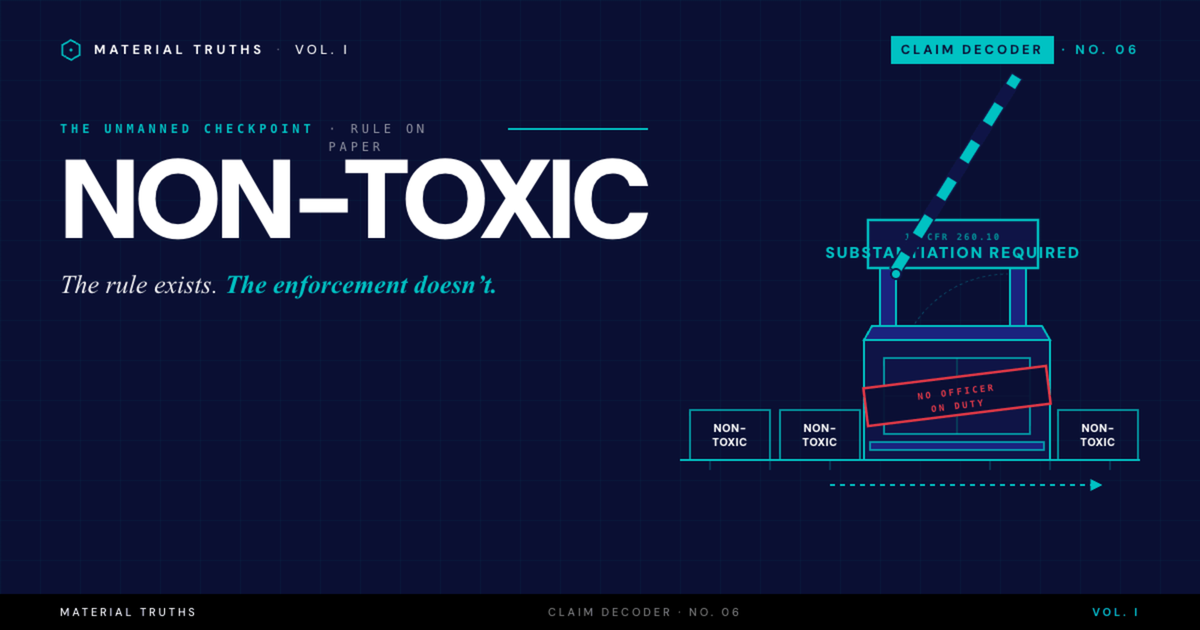
The FTC's Green Guides at 16 CFR 260.10 explicitly address non-toxic claims: "It is deceptive to misrepresent, directly or by implication, that a product, package, or service is non-toxic." Non-toxic claims convey to consumers that a product poses no meaningful toxicity risk to humans or the environment, and brands making the claim must have competent and reliable scientific evidence substantiating it. Despite this requirement, there is no specific testing standard for "non-toxic" and no pre-approval process. The term appears widely on cleaning products, cosmetics, baby products, and pet products — frequently without the substantiation the FTC requires.
What does "non-toxic" legally mean?
The FTC Green Guides — the authoritative framework for environmental marketing claims — address non-toxic claims directly at 16 CFR 260.10. The regulation makes three things clear:
- It is deceptive to misrepresent that a product, package, or service is non-toxic
- Non-toxic claims convey to consumers that the product is non-toxic both for humans and for the environment generally
- Marketers making these claims must have competent and reliable scientific evidence to substantiate them
This is meaningfully different from "hypoallergenic" or "clinical-grade," which have no legal definition. "Non-toxic" has a substantiation requirement — the brand must be able to prove it. The issue is that the FTC does not pre-approve or verify non-toxic claims. Enforcement happens after the fact, through FTC action, NAD proceedings, or class action litigation.
This creates an asymmetry: the legal standard exists but is rarely proactively enforced, so unsubstantiated non-toxic claims proliferate despite the regulation.
What does the FTC require for non-toxic substantiation?
The general substantiation principle at 16 CFR 260.2 applies to non-toxic claims: brands must have a reasonable basis before making the claim. For environmental and health claims, this typically means competent and reliable scientific evidence — "tests, analyses, research, or studies that have been conducted and evaluated in an objective manner by qualified persons and are generally accepted in the profession to yield accurate and reliable results."
For non-toxic claims specifically, the evidence must cover:
- Non-toxicity to humans. Under the exposure conditions consumers would reasonably experience.
- Non-toxicity to the environment. Including during manufacture, use, and disposal.
The FTC also expects non-toxic claims to be appropriately qualified:
- Unqualified "non-toxic" implies absolute non-toxicity, which is almost impossible to substantiate.
- "Non-toxic when used as directed" is more defensible because it narrows the claim to intended use.
- "Non-toxic for humans and pets" specifies audiences but still requires environmental substantiation separately.
Can any product really be fully non-toxic?
The fundamental principle of toxicology, attributed to the 16th-century physician Paracelsus, holds that the dose makes the poison. Water can cause hyponatremia in high doses. Salt is acutely toxic in sufficient quantities. Oxygen at elevated partial pressures damages tissue. Every substance has some threshold at which it causes harm.
"Non-toxic," taken literally, is therefore unattainable for virtually any product. This is why the FTC requires qualified, substantiated claims rather than treating "non-toxic" as a binary descriptor.
In practice, reasonable non-toxic claims reference:
- Absence of specific toxic substances (often tied to lists like California's Proposition 65)
- Safety under intended use conditions
- Low toxicity relative to conventional alternatives
- Certification to specific safety standards
When a brand uses "non-toxic" as an unqualified absolute, the claim is both substantively problematic (nothing is absolutely non-toxic) and legally vulnerable (unsubstantiated under Green Guides).
How does "non-toxic" compare to "chemical-free"?
Both are common marketing claims. Both are problematic.
"Chemical-free" is literally impossible. Water is a chemical (H2O). Proteins, carbohydrates, and fats are chemicals. Even "natural" botanical extracts are complex mixtures of chemical compounds. The FTC Green Guides caution against unqualified chemical-free claims because they cannot be substantiated — every product contains chemicals by definition.
"Non-toxic" is technically evaluable but often unsubstantiated in consumer marketing. The claim can be supported when appropriately qualified and backed by evidence.
Both terms appear extensively in:
- "Clean beauty" cosmetics and skincare
- Natural cleaning product lines
- Baby and children's products
- Pet products
- Food packaging ("chemical-free plastics")
The appeal is emotional rather than scientific — "chemical-free" signals wholesomeness to consumers uncomfortable with industrial manufacturing, regardless of what chemistry actually means. Brands know this; the marketing exploits the gap between consumer interpretation and technical reality.
Certifications that substantiate non-toxic claims
Several voluntary third-party programs provide real verification of specific non-toxic attributes:
EPA Safer Choice (epa.gov/saferchoice). EPA's own program evaluating cleaning and similar products against specific chemical screening criteria. Products meeting criteria can use the Safer Choice label. Database searchable at epa.gov.
Green Seal (greenseal.org). Independent nonprofit certifying environmental and health attributes of cleaning products, paints, paper, and other categories. Standard GS-37 covers institutional cleaning products; other standards address other categories.
MADE SAFE (madesafe.org). Certifies consumer products against a list of toxic chemicals. Focuses on personal care, baby, household, and apparel.
EWG Verified (ewg.org/ewgverified). Environmental Working Group's certification for personal care products meeting EWG's standards for ingredient avoidance.
USDA Organic (usda.gov/topics/organic). Verifies absence of prohibited synthetic substances in food and agricultural products.
OEKO-TEX STANDARD 100 (oeko-tex.com). Tests textiles for harmful substances including heavy metals, formaldehyde, pesticides, phthalates, and other chemicals.
None of these is specifically "non-toxic certification" as a category, but each involves real testing against specific standards and provides meaningfully more information than an unqualified "non-toxic" label.
California Proposition 65 interaction
California's Proposition 65 (the Safe Drinking Water and Toxic Enforcement Act of 1986) requires warnings for products containing any of more than 900 listed chemicals known to cause cancer, birth defects, or other reproductive harm. The list is maintained by California's Office of Environmental Health Hazard Assessment (OEHHA).
Products containing Prop 65-listed chemicals must carry warning labels. A product simultaneously labeled "non-toxic" and carrying a Prop 65 warning creates direct evidence of deceptive labeling. This inconsistency has been the basis of numerous California consumer class actions.
Verification workflow for Prop 65:
- Check if the product carries a Prop 65 warning label
- Search the OEHHA list at oehha.ca.gov/proposition-65/proposition-65-list
- Review the product's ingredient list for listed chemicals
- If listed chemicals are present and the product claims "non-toxic" without qualification, the claim is likely deceptive under California law
Legal risks for false non-toxic claims
Multiple enforcement vectors apply:
- FTC enforcement. Section 5 of the FTC Act and Green Guides 16 CFR 260.10 provide direct authority.
- California Proposition 65 class actions. Products containing listed chemicals that claim non-toxicity create direct liability exposure.
- State consumer protection class actions. California CLRA, New York GBL §§ 349 and 350, and similar statutes enable private enforcement.
- Product liability. When non-toxic-labeled products cause actual harm, injury claims can leverage the false labeling.
- NAD proceedings. Competitors can challenge non-toxic claims at BBB National Programs' National Advertising Division.
- EU Greenwashing Directive (effective September 27, 2026). For products sold in Europe, general environmental benefit claims including non-toxicity are subject to stricter substantiation requirements.
The cumulative legal exposure is real, even though enforcement of any single framework is inconsistent. Brands making non-toxic claims should maintain substantiation records that would hold up across multiple regulatory and litigation contexts.
Frequently asked questions
What does "non-toxic" legally mean? FTC Green Guides at 16 CFR 260.10 require substantiation for both human and environmental non-toxicity. Unqualified claims without evidence are deceptive.
What does FTC require for substantiation? Competent and reliable scientific evidence under 16 CFR 260.2.
Can any product really be fully non-toxic? Technically no — the dose makes the poison. The FTC requires qualified, substantiated claims.
How does "non-toxic" compare to "chemical-free"? Both are problematic; chemical-free is literally impossible, non-toxic requires substantiation that most brands don't have.
What certifications do back up non-toxic claims? EPA Safer Choice, Green Seal, MADE SAFE, EWG Verified, USDA Organic, OEKO-TEX STANDARD 100.
Legal risks? FTC, California Prop 65, state consumer protection class actions, product liability, NAD, EU Greenwashing Directive.
Further reading
- Greenwashing: The broader pattern non-toxic claims fit into
- Claim decoder: "Eco-Friendly": Adjacent general environmental claim
- Claim decoder: "Hypoallergenic": Related unregulated safety term
- Sciencewashing: Broader deception pattern
Sources
- FTC. "Guides for the Use of Environmental Marketing Claims." 16 CFR Part 260, specifically §260.10 Non-toxic claims. ftc.gov/legal-library/browse/rules/green-guides
- 16 CFR 260.2 — Interpretation and substantiation of environmental marketing claims.
- California Proposition 65 (Safe Drinking Water and Toxic Enforcement Act of 1986). oehha.ca.gov/proposition-65
- EPA Safer Choice. epa.gov/saferchoice
- Green Seal. greenseal.org
- MADE SAFE. madesafe.org
- EWG Verified. ewg.org/ewgverified
- OEKO-TEX STANDARD 100. oeko-tex.com