Shell Company Consumer Brands: How to Find Out Who Actually Owns a DTC Company

Last updated: May 4, 2026
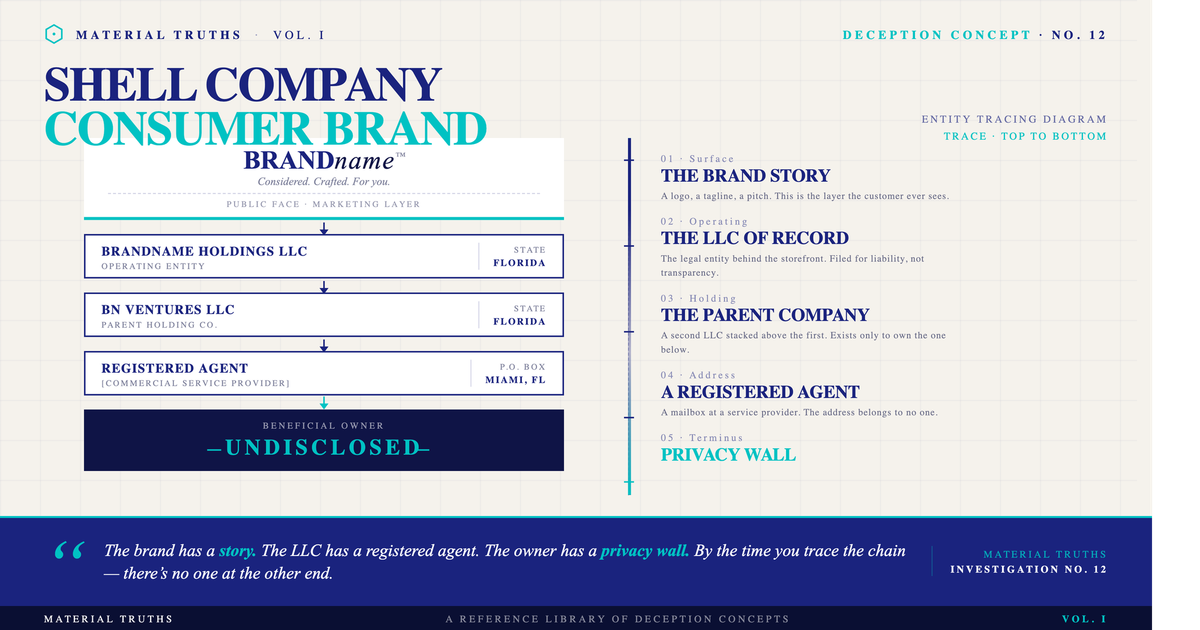
A shell company in consumer branding is an LLC with no independent physical operations that exists primarily to hold a consumer brand, own its domain and trademark, accept payments, and limit the legal exposure of the operators. Most DTC brands use LLCs — that is normal. The structure becomes concerning when it's used to obscure who is actually running the brand, to rapidly rotate identities after enforcement, or to disconnect accountability from the people making marketing claims. Delaware, Nevada, and Wyoming are the most common jurisdictions because they permit maximum privacy with minimal disclosure requirements.
What is a shell company in consumer branding?
The term "shell company" has a precise financial meaning (an entity without active business operations or significant assets), and a broader colloquial meaning (an entity used primarily to hold something while obscuring ownership). Both meanings apply to consumer brand LLCs.
A typical DTC shell company structure:
- A Wyoming, Nevada, or Delaware LLC is registered. Filing fee: $50-$300 depending on state.
- The LLC's registered agent is a commercial service (Northwest Registered Agent, Registered Agents Inc., Harvard Business Services, etc.). The registered agent's address becomes the public mailing address — not the operator's actual address.
- The LLC is listed as the operator in the brand's Terms of Service and Privacy Policy.
- The LLC holds the trademark registration at USPTO (if one exists), the domain, and the payment processor accounts.
- The actual humans running the brand are often not named in public records. Some states require organizer names but not member (owner) names. Wyoming allows complete anonymity.
This structure is legal and widely used for perfectly legitimate reasons: liability limitation, tax optimization, privacy from harassment, and separation of personal from business affairs. Small business owners routinely use LLCs for these purposes.
The structure becomes problematic when it serves to:
- Obscure that a single operator runs multiple consumer brands simultaneously
- Allow rapid brand rotation after enforcement, platform bans, or negative press
- Hide foreign ownership from consumers who would prefer domestic brands
- Disconnect the humans making deceptive claims from personal liability
- Enable the same operator to escape consequences by dissolving one LLC and starting another
Why do DTC brands use shell LLCs?
Legitimate reasons:
- Liability limitation. If a product causes harm, the LLC absorbs the liability rather than the owner's personal assets. This is the primary purpose of any LLC.
- Tax structuring. Pass-through taxation, the ability to elect S-corp treatment, and flexibility in expense allocation.
- Privacy. Business owners reasonably want separation between their personal identity and their business presence. Harassment and doxing are real concerns.
- Investment readiness. Delaware C-corp structures are standard for venture-funded businesses; LLCs are often interim steps.
- Simplicity. LLCs are easier to form, maintain, and dissolve than corporations.
Less legitimate reasons:
- Portfolio concealment. A single operator runs 10 TikTok Shop brands targeting different demographics. Keeping them visibly separate requires that the common ownership be obscured. The shell structure accomplishes this.
- Enforcement evasion. When a brand faces consumer protection action, negative reviews, or platform enforcement, the operator dissolves the LLC and starts a new one with new branding. The prior record is attached to the dissolved entity; the new entity starts with a clean slate.
- Foreign ownership concealment. Many operators physically located outside the United States use U.S. LLCs to appear domestic. The LLC is U.S.-registered; the actual humans running it are not in the U.S. Consumers assume a U.S. presence based on the LLC structure.
- Personal liability limitation for deception. While LLCs protect owners from product liability, they do not typically shield owners from personal liability for fraud or intentional misrepresentation. But making the operator hard to find is itself a practical shield.
How can consumers trace a brand's true ownership?
A practical investigation workflow:
1. Start with the brand's own disclosures. Terms of Service and Privacy Policy almost always name the operating LLC. Look for language like "This website is operated by [LLC Name]..." or "Privacy questions may be directed to [LLC Name] at [address]." The LLC name is your starting point.
2. Search the state business entity database. Every state has a Secretary of State business entity search. Key ones:
- Delaware: icis.corp.delaware.gov
- Nevada: nvsos.gov
- Wyoming: wyobiz.wyo.gov
- California: bizfileonline.sos.ca.gov
- Texas: sosdirect.sos.state.tx.us
- Florida: sunbiz.org
Enter the LLC name. You'll typically get: registered agent name and address, mailing address, organizer name, formation date, and filing status (active, dissolved, delinquent).
3. Use OpenCorporates. Located at opencorporates.com. Free database that aggregates corporate filings from jurisdictions worldwide. Search an LLC name and see filings across multiple states and countries. Particularly useful when one operator has LLCs in multiple states.
4. Check USPTO trademark assignment records. USPTO Trademark Status and Document Retrieval (tsdr.uspto.gov) shows who owns trademarks and whether they've been assigned between entities. Trademark assignments sometimes reveal prior owners or related companies.
5. Cross-reference addresses and agents. Same registered agent across multiple LLCs is not proof of common ownership (agents serve many clients). But same mailing address, same organizer name, same authorized signer, or same principal office address across multiple LLCs strongly suggests connected operations.
6. Check import records. ImportYeti (importyeti.com) aggregates U.S. customs import records from bills of lading. If the LLC imports goods, the records often reveal supplier relationships and sometimes foreign parent or affiliate entities.
7. Search for domain registration history. Tools like DomainIQ and DomainTools track historical WHOIS records. Even when current WHOIS is privacy-protected, historical records may reveal prior ownership before privacy protection was enabled.
8. Reverse search through prior litigation. Court databases (PACER for federal, state court databases for state cases) reveal prior lawsuits. Multiple LLCs sharing the same defendant counsel or the same individual defendants in prior cases often reveals connected operations.
What does state of incorporation tell you?
Incorporation state signals priorities. A quick reference:
| State | What it signals | Common use case |
|---|---|---|
| Delaware | Sophisticated structuring, future fundraising | Venture-backed startups, corporate HQs |
| Nevada | Strong privacy, operator-friendly | Small businesses, privacy-focused operators |
| Wyoming | Maximum privacy, low cost, anonymous LLCs allowed | Drop shippers, rapid-rotation operations |
| California | Physical operations in CA, higher transparency | Brands with actual CA presence |
| Texas | Business-friendly, moderate privacy | Southern/Southwest operators |
| Florida | Similar to Texas | Southeast operators |
| New York | Strong consumer protection, significant operators | NYC-based brands, larger operations |
A DTC brand incorporated in Wyoming or Nevada is not automatically suspicious — the states offer legitimate privacy benefits. But combined with vague "About Us" content, no physical address, no named founders, recent domain registration, and drop-ship indicators, the privacy-friendly jurisdiction becomes part of a pattern worth investigating.
Can multiple brands have the same owner?
Yes, and identifying connections between seemingly unrelated brands is often the most revealing step in a brand investigation.
Common signals of connected ownership:
- Identical registered agents (weaker signal — agents serve many clients)
- Same mailing address across LLCs (stronger signal)
- Same organizer or authorized person listed on state filings (strong signal)
- Shared marketing agency producing similar visual style, copy patterns, or creator partnerships
- Identical payment processor descriptors on credit card statements
- Sister brands selling near-identical products with matching AliExpress suppliers
- Coordinated social media activity across nominally separate accounts
- Common phone number or email in trademark filings
- Shared physical infrastructure (same warehouse, same return address on packages)
Corporate filings are public. OpenCorporates and direct state database searches make cross-referencing possible in minutes. The operators of related brands frequently don't anticipate that connections will be documented — finding and publishing the connections is one of the most valuable editorial functions of brand investigations.
The Corporate Transparency Act (relevant context)
The Corporate Transparency Act (CTA), enacted in 2021 with reporting requirements that phased in through 2024-2025, requires most U.S. LLCs to disclose their beneficial owners to FinCEN (the Financial Crimes Enforcement Network). Beneficial owners are the humans who ultimately own or control the entity.
What this means for consumer investigations:
- FinCEN now has a database of ultimate LLC ownership
- The database is not publicly accessible — it's available to law enforcement, certain regulators, and financial institutions performing due diligence
- Consumers and journalists cannot directly query beneficial ownership
- However, FTC, state AGs, and other enforcement agencies can access the database when pursuing cases
The CTA represents a meaningful shift in the accountability landscape for shell LLCs. Bad actors who previously relied on Wyoming's anonymity provisions to escape consequences now have their identities on file with FinCEN, discoverable to regulators. This doesn't solve the consumer-facing transparency problem, but it does mean enforcement agencies have investigative tools that were unavailable before.
Are shell company brand structures illegal?
Shell LLC structures themselves are legal and routine. What becomes illegal:
- Using the shell to facilitate fraud (civil or criminal)
- Using the shell to evade court judgments or regulatory orders
- Using the shell to hide assets from legitimate creditors
- Using the shell to continue consumer protection violations after enforcement against a prior entity (known as "phoenix companies" — dissolving one entity and rising again as another to escape consequences)
- Using the shell for money laundering (independently illegal)
The FTC and state AGs have mechanisms to pierce corporate structures when fraud is found. Court orders can name individual operators, not just LLC shells, particularly when evidence supports that the shell was used to facilitate or conceal deceptive practices.
Frequently asked questions
What is a shell company in consumer branding? An LLC that holds a consumer brand without independent operations, used to limit operator liability and often to obscure ownership.
Why do DTC brands use shell LLCs? Legitimate reasons (liability, tax, privacy) and less legitimate reasons (portfolio concealment, enforcement evasion, foreign ownership concealment).
How can consumers trace a brand's true ownership? Start with Terms of Service for LLC name, search state entity databases, use OpenCorporates, check USPTO trademarks, cross-reference addresses and agents.
What does state of incorporation tell you? Delaware signals sophistication/fundraising, Nevada and Wyoming signal privacy preference, California/Texas/Florida signal physical operations.
Can multiple brands have the same owner? Yes, and identifying those connections is often the most revealing investigative step.
Are shell company structures illegal? The structures themselves are legal. Using them to facilitate fraud or evade accountability is not.
Further reading
- Drop Shipping Scam: Shell structures commonly enable drop shipping operations
- Made in USA: Origin deception often hides behind shell structures
- FTC Consent Order: How enforcement reaches past shell structures
Sources
- Corporate Transparency Act of 2021. fincen.gov/boi
- OpenCorporates. opencorporates.com
- USPTO Trademark Status and Document Retrieval. tsdr.uspto.gov
- ImportYeti. importyeti.com
- State Secretary of State business entity databases (Delaware, Nevada, Wyoming, California, Texas, Florida).